Key takeaways
- 016 of 18 apps declare data used to track you across other companies' apps and sites.
- 0212 of 18 declare data linked to your identity; 10 link your email address.
- 032 of 18 declare that they collect no data at all.
- 046 of 18 sell a lifetime unlock; 2 cannot be used without a subscription.
On this page
LiftLoggr is our app. We read the US App Store listings of 18 other lifting apps on 2026-11-14 and recorded two things for each: how you pay, and what its privacy label declares. Short answer: 6 of 18 declare data used to track you, 12 of 18 declare data linked to your identity, and only 2 declare that they collect nothing. On price, 6 of 18 sell a lifetime unlock and 2 cannot be used at all without a subscription.
This page is a snapshot of what the developers say about their own apps, not a test of what the apps actually send. We did not install or run them. Everything below can be re-checked by anyone in about an hour; the method is at the end.
The headline numbers
18 apps, US storefront, 2026-11-14. LiftLoggr is reported separately and is not counted in these totals.
| What the label or listing says | Apps | Share |
|---|---|---|
| Declares Data Used to Track You | 6 | 33% |
| Declares Data Linked to You | 12 | 67% |
| Links your email address to you | 10 | 56% |
| Links fitness or health data to you | 10 | 56% |
| Lists Third-Party Advertising as a purpose | 5 | 28% |
| Declares Data Not Linked to You and nothing else | 3 | 17% |
| Declares Data Not Collected | 2 | 11% |
| Lists a lifetime or one-time unlock for its Pro tier | 6 | 33% |
| Paid app with no subscription | 1 | 6% |
| Can’t be used without a subscription (listing says so) | 2 | 11% |
Three patterns stand out.
- Most apps tie your training to you. Twelve apps declare data linked to your identity. In ten of them that includes “Fitness” or “Health”, which is the data type that holds your workouts. That fits apps built around an account and a server: your log lives with the company, under your email.
- Tracking is a minority, but a real one. JEFIT, Fitbod, Boostcamp, Alpha Progression, Lyfta and Gymverse declare data used to track you. What they declare is narrow in most cases: Product Interaction for JEFIT and Fitbod, a User ID for Boostcamp, Device ID and Purchase History for Alpha Progression. Lyfta declares four types, including Advertising Data. Gymverse declares Fitness data.
- Lifetime unlocks are common among indie and mid-size apps. Strong, Hevy, Liftosaur, GymBook, Setgraph and GymLogger X all name a lifetime or one-time Pro product on the listing. The cheapest lists at US$22.99 (GymBook), the most expensive at US$199.99 (Setgraph).
Privacy labels, app by app
Apple sorts each label into up to three sections plus a “Data Not Collected” badge. We list the categories in each section exactly as the listing shows them. The data-type counts in the apps table above come from the expanded label.
| App | Data Used to Track You | Data Linked to You | Data Not Linked to You |
|---|---|---|---|
| Strong | none | Contact Info, Diagnostics, Health & Fitness, Identifiers, Other Data, Purchases | none |
| Hevy | none | Contact Info, Contacts, Purchases, Usage Data | Diagnostics, Identifiers, Sensitive Info |
| JEFIT | Usage Data | none | Contact Info, Diagnostics, Health & Fitness, Identifiers, Location, Usage Data, User Content |
| Fitbod | Usage Data | Contact Info, Diagnostics, Health & Fitness, Identifiers, Usage Data, User Content | none |
| Boostcamp | Identifiers | Identifiers | Contact Info, Diagnostics, Location, Usage Data |
| Liftosaur | none | Contact Info, Diagnostics, Health & Fitness, Identifiers, Usage Data, User Content | none |
| Stronglifts | none | none | Diagnostics, Identifiers, Purchases, Usage Data |
| GymBook | Data Not Collected | ||
| Streaks Workout | none | none | Diagnostics |
| Alpha Progression | Identifiers, Purchases | Contact Info, Health & Fitness, Identifiers, Purchases, Usage Data, User Content | none |
| MacroFactor Workouts | none | Contact Info, Diagnostics, Health & Fitness, Identifiers, Purchases, Usage Data, User Content | none |
| Setgraph | none | Contact Info, Health & Fitness, Identifiers, User Content | Diagnostics, Health & Fitness, Identifiers, Purchases, Usage Data |
| Lyfta | Identifiers, Usage Data | Contact Info, Health & Fitness, Identifiers, Usage Data | Diagnostics |
| RepCount | none | Contact Info, Health & Fitness, Identifiers, Purchases, User Content | Diagnostics, Usage Data |
| Gymverse | Health & Fitness | Health & Fitness | Diagnostics, Usage Data |
| SmartGym | none | none | Diagnostics, Usage Data |
| GymLogger X | Data Not Collected | ||
| Liftoff | none | Contact Info, Health & Fitness, Identifiers, User Content | Diagnostics |
| LiftLoggr (ours) | none | none | Usage Data |
The five apps whose labels list Third-Party Advertising as a purpose are JEFIT, Boostcamp, Alpha Progression, Setgraph and Lyfta. Apple’s definition covers “displaying third-party ads in your app, or sharing data with entities who display third-party ads”. So the purpose can appear on an app that shows no ads itself: Boostcamp’s and Alpha Progression’s listings both say “No ads”.
How to read a label
- Data Used to Track You. Apple defines tracking as linking data from the app “with Third-Party Data for targeted advertising or advertising measurement purposes, or sharing data … with a data broker”. It is the strongest disclosure on the label.
- Data Linked to You. Data tied to your identity “via their account, device, or other details”. An app with an account and cloud sync almost always lands here, because your workouts are stored under your account.
- Data Not Linked to You. Collected, but de-identified before collection. Crash reports and anonymous usage counts usually sit here.
- Data Not Collected. The developer and its third-party partners collect nothing from the app.
Every listing carries the same line: the developer “indicated that the app’s privacy practices may include handling of data as described below. This information has not been verified by Apple.” A label is a promise, not an audit.
Pricing models, app by app
The US App Store page shows up to 10 in-app purchases per app, with the product name the developer chose. We report what those names say. Where every product has the same name (Boostcamp, Lyfta, Gymverse, Liftoff), the listing doesn’t tell you which price is monthly, yearly or lifetime, so we give the range only.
| Model | Apps |
|---|---|
| Free tier, plus subscription or a lifetime unlock | Strong, Hevy, Liftosaur, GymBook, Setgraph, GymLogger X |
| Free tier, plus subscription; no lifetime product named on the listing | JEFIT, Boostcamp, Alpha Progression, Lyfta, RepCount, Gymverse, SmartGym, Liftoff |
| Trial, then subscription | Fitbod (7 days, per its listing) |
| Subscription required to use | Stronglifts (“free to download, but requires a subscription to use”), MacroFactor Workouts (“does not offer a free subscription tier”) |
| Paid app, no subscription | Streaks Workout (US$4.99, optional one-time workout packs) |
Stronglifts sells a 5-year plan (US$199.99 and US$239.99 are both listed). That is a long prepaid term, not a lifetime unlock.
Several listings show two prices for the same product name: Strong PRO Forever at US$99.99 and US$79.99, Hevy Pro monthly at US$2.99 and US$3.99, Fitbod’s yearly plan at US$79.99 and US$95.99. Apple’s page doesn’t say which one a new customer sees. Read these as “the developer has sold it at both prices”, and check the paywall before you buy.
Lifetime prices, US and Germany
We repeated the check on the German storefront (apps.apple.com/de/) the same day, as one EU reference. The privacy labels showed the same sections in both storefronts; only prices change. EU App Store prices include VAT; US prices are shown before sales tax, so the two columns are not a currency conversion.
| App | Lifetime product (listing name) | US | Germany |
|---|---|---|---|
| GymBook | GymBook Pro · Lifetime | US$22.99 | 24,99 € |
| GymLogger X | GymLogger X Pro Lifetime | US$39.99 | 44,99 € |
| Hevy | Hevy Pro - Lifetime | US$74.99 | 89,99 € |
| Strong | Strong PRO Forever | US$99.99 and US$79.99 | 99,99 € and 89,99 € |
| Liftosaur | Lifetime Subscription | US$99.99 | 74,99 € |
| Setgraph | Lifetime Pro Membership | US$199.99 | 139,99 € |
The spread inside one storefront is wide: the most expensive lifetime unlock costs almost nine times the cheapest in the US. And storefront matters: Liftosaur’s and Setgraph’s lifetime unlocks list lower in euros than in dollars, Hevy’s lists higher. Streaks Workout costs US$4.99 in the US and 5,99 € in Germany.
Account and export, where we could verify it
A label doesn’t say whether you need an account or whether you can take your data out. We checked those only where the developer states it on its listing, website or help centre. “Not checked” in the apps table means we found no first-party statement, not that the feature is missing.
| App | Account | Export | Source |
|---|---|---|---|
| Strong | “All users will be prompted to sign up for an account before using Strong.” | CSV; “exported files cannot be imported back into Strong” | Strong Help Center |
| Hevy | Data is “stored on your Hevy account, not on the device” | Export workouts or measurements; import accepts Strong CSV only | Hevy Help Center |
| Liftosaur | “You can use the app without an account and without a connection.” | Full JSON backup, CSV history, programs as text; JSON and CSV import back | liftosaur.com |
| Alpha Progression | “No account required.” | “Export everything as CSV”, listed as free | App Store listing |
| RepCount | Sign in with Apple, Google or email for backup and sync | CSV export with Premium | App Store listing |
| GymBook | None mentioned; label says Data Not Collected | CSV, XML and a database backup, sold as Pro or as a separate Export unlock | gymbookapp.com, listing |
| GymLogger X | “No account to make.” | No CSV export; workouts go to Apple Health | listing, lagerland.app |
| LiftLoggr | No account | History as CSV; full JSON backup you can restore | our app |
Where LiftLoggr sits, honestly
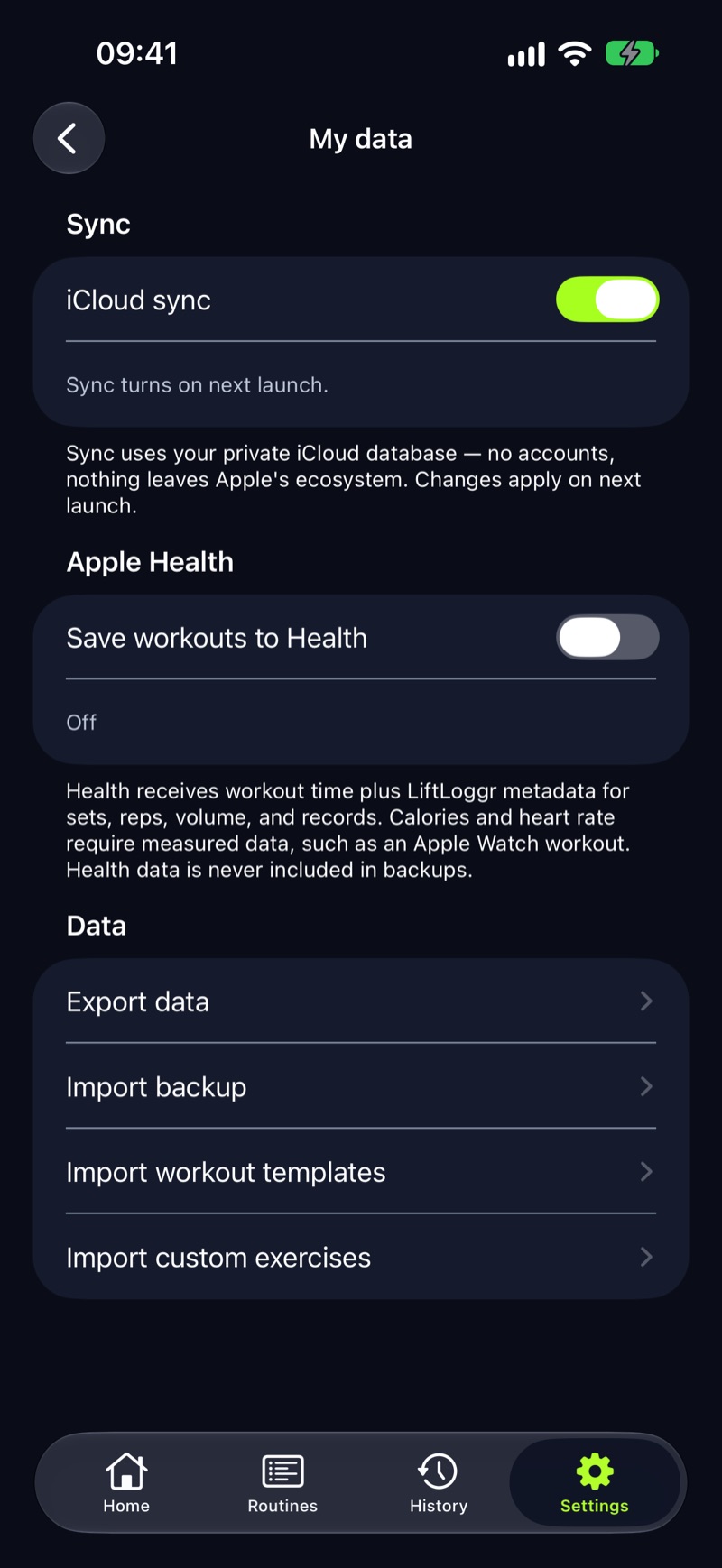
LiftLoggr’s label is in the “Data Not Linked to You” group with Stronglifts, Streaks Workout and SmartGym. It declares two data types, Product Interaction and Other Usage Data, for Analytics. That is the anonymous usage analytics in the iPhone app: on by default for App Store installs, off with one switch in Settings → My data. No account, no identity, no location from your IP address. Your workouts, routines, notes and backups are not part of it; they stay on your iPhone, or in your own private iCloud database if you turn on sync. Details are in our privacy policy.
So LiftLoggr does not belong in the “Data Not Collected” row, and we don’t claim it does. If a zero-collection label is your hard line, GymBook and GymLogger X are the two apps in this set that declare it.
On price, LiftLoggr is one unlock for the whole app, with no per-feature locks, and export and backup restore are never behind a paywall. The current terms come straight from the store: LiftLoggr is free today. LiftLoggr Pro arrives with the December update, and everyone who installs before then keeps the whole app free for good.
A new in-app purchase can change a label (Apple has a Purchases category). We’ll re-check our own row, and every other row, when LiftLoggr Pro ships and again every 90 days.
What this study can’t tell you
- Labels are self-declared. We compared declarations, not network traffic. An app could under-declare; nothing here detects that.
- The IAP list is capped at 10. Apps with many price points (JEFIT, Fitbod, Boostcamp, Lyfta, Gymverse, Liftoff, SmartGym) may sell more products than the page shows.
- Product names are the developer’s. “Lifetime Subscription” (Liftosaur) is a one-time product by name; we did not buy anything to confirm terms.
- Free tiers change. Hevy’s help centre caps free users at 4 routines and 7 custom exercises; SmartGym’s listing caps free at 2 routines and 3 workouts. Limits like these move often. Check the date on any row before relying on it.
- 18 is a sample. We picked apps that rank for lifting searches or come up in comparisons, plus the indie apps that sell on privacy. It is not every lifting app on the store.
Method: reproduce it yourself
- Find the app ID. Search
https://itunes.apple.com/search?term=<name>&entity=software&country=us. ThetrackIdis the ID. Our 18 IDs: Strong 464254577, Hevy 1458862350, JEFIT 449810000, Fitbod 1041517543, Boostcamp 1529354455, Liftosaur 1661880849, Stronglifts 488580022, GymBook 650113307, Streaks Workout 1044950341, Alpha Progression 1462277793, MacroFactor Workouts 6737156524, Setgraph 1209781676, Lyfta 6443740936, RepCount 594982044, Gymverse 1048454034, SmartGym 922744883, GymLogger X 6755734580, Liftoff 6448081563. LiftLoggr is 6788341894. - Read the upfront price.
https://itunes.apple.com/lookup?id=<id>&country=usreturnsformattedPrice(“Free” or a price). Swapcountry=defor Germany. - Open the listing.
https://apps.apple.com/us/app/id<id>. Under Information → In-App Purchases you get up to 10 product names and prices. Under App Privacy, “See Details” opens the full label with sections, purposes, categories and data types. - Record exactly what is shown, with the date and storefront. Don’t infer a billing period from a price.
- Account and export: use only the developer’s own listing, website or help centre, and quote it.
We fetched all 19 listings, US and German, on 2026-11-14 and parsed the same data the page renders. Found a row that has changed? Tell us and we’ll re-check it and update the date.
Related
- Pay once instead of renting: workout apps without a subscription.
- Which tracker fits how you train: best workout tracker apps.
- How LiftLoggr works with no account and no signal: offline workout tracker.
Questions
Which lifting apps collect no data, according to their App Store labels?
Of the 18 apps we checked on 2026-11-14, two declare Data Not Collected: GymBook and GymLogger X. Three more declare only data not linked to you: Stronglifts, Streaks Workout and SmartGym. LiftLoggr is in that second group.
Are App Store privacy labels verified by Apple?
No. Each listing says the information comes from the developer and has not been verified by Apple. Developers must keep their answers accurate, but a label is a self-declaration, not an audit.
What does 'Data Used to Track You' mean?
Apple defines tracking as linking data from the app with data from other companies' apps, websites or offline properties for targeted advertising or ad measurement, or sharing it with data brokers. Six of the 18 apps declare it.
Which lifting apps have a lifetime purchase?
On the US App Store on 2026-11-14: Strong, Hevy, Liftosaur, GymBook, Setgraph and GymLogger X list a lifetime or one-time Pro product. Streaks Workout is a paid app with no subscription, but it is a timed home-workout app, not a lifting log.
Does LiftLoggr collect any data?
Yes, a little. Its label declares Product Interaction and Other Usage Data, not linked to you, for analytics: anonymous usage events you can switch off in Settings. Workouts, routines and notes are not sent; they stay on your device or in your own iCloud.
Sources
- Apple: App privacy details on the App Store (label definitions) developer.apple.com
- Apple: User privacy and data use (definition of tracking) developer.apple.com
- Apple: iTunes Search API lookup used to resolve app IDs and list prices itunes.apple.com
- Strong: platforms (iPhone, Android, Apple Watch) strong.app
- Hevy Help Center: features guide, free vs Pro and platforms help.hevyapp.com
- Strong Help Center: Why do I need a Strong account? help.strongapp.io
- Strong Help Center: Can I export my workout data? help.strongapp.io
- Hevy Help Center: Login options explained help.hevyapp.com
- Hevy Help Center: Import Strong CSV files and export your data help.hevyapp.com
- Liftosaur: Sync and offline liftosaur.com
- Liftosaur: Import and export liftosaur.com
- GymBook: features and GymBook Pro gymbookapp.com
- Lagerland Apps: GymLogger X vs Strong lagerland.app