
Key takeaways
- 01Record weight × reps for every working set, plus reps in reserve if you can.
- 02Compare each set with the same set last time, not with your best ever.
- 03Overload counts if reps, load or sets go up at the same effort, or effort goes down at the same work.
- 04Review weekly per lift; act after three flat sessions, not one.
On this page
To track progressive overload, write down the weight and reps of every working set, compare each set with the same set from your last session, and beat at least one of them by a rep or a small weight jump. Add reps in reserve (RIR) if you can, and review each lift’s trend once a week.
That’s the whole method. The rest of this guide is the detail that makes the comparison honest: what to record, what counts as progress, which numbers to chart and what to do when the numbers stop moving.
What to record for every set
| Field | Why it matters | Example |
|---|---|---|
| Exercise (exact variation) | Incline and flat bench are different lifts | Barbell bench press |
| Set type | Warm-ups and drop sets don’t count toward progress | Working |
| Weight, with unit | The load | 62.5 kg |
| Reps | The work | 10 |
| Reps in reserve | Effort: separates “harder” from “heavier” | 2 |
| Rest (if it changed) | Short rest costs reps | 2:00 |
| Notes (only when something changed) | Explains an outlier | “Pause reps”, “Bad sleep” |
Skip everything else. Mood scales, calories and long journal entries don’t help you decide what to lift next session. For a full list of what belongs in a training log, see what to write in a workout journal.
Five ways overload shows up in a log
Progressive overload isn’t only “more weight”. The log shows it in five ways:
| Change at the next session | Same exercise, same sets | Counts as overload? |
|---|---|---|
| More weight, same reps | 60 × 10 → 62.5 × 10 | Yes |
| Same weight, more reps | 60 × 10 → 60 × 11 | Yes |
| Same weight and reps, one more set | 3 × 10 → 4 × 10 | Yes, if the extra set is a hard set |
| Same weight and reps, more reps in reserve | 60 × 10 @ RIR 1 → @ RIR 3 | Yes: same work, less effort |
| Same numbers, cleaner reps or fuller range | Paused, deeper, slower | Yes, but note it |
| More weight, fewer reps, more effort | 60 × 10 → 65 × 6 @ RIR 0 | Not necessarily |
The last row fools people. A heavier weight for fewer reps can be a weaker set. That’s why you need reps and effort next to the weight. Adding reps works as well as adding load for muscle growth: an 8-week trial with trained lifters found similar results for both, with a small strength edge for adding load (Plotkin et al. 2022).
Compare like with like
Most “I’m not progressing” stories are comparison errors.
- Same set, same position. Compare set 2 with last time’s set 2, not with your best set ever. Fatigue makes set 3 weaker than set 1 every week.
- Same exercise variation. Changing grip, bench angle, bar or machine starts a new history.
- Same unit. 60 kg is 132.3 lb. Mixing units in one log hides progress.
- Same rest. Ninety seconds instead of three minutes costs reps. Keep rest consistent; see rest between sets.
- Warm-ups out. A warm-up ramp changes with the working weight. Don’t count it as progress.
A logbook excerpt
Here is a worked bench log over four weeks, 3 × 8–12, run with double progression. Est. 1RM is the Brzycki estimate from the best set.
| Week | Session | Sets | Best set | Est. 1RM | Verdict |
|---|---|---|---|---|---|
| 1 | Mon | 60 × 10, 9, 8 | 60 × 10 | 80.0 kg | Baseline |
| 1 | Thu | 60 × 11, 10, 9 | 60 × 11 | 83.1 kg | +3 reps |
| 2 | Mon | 60 × 12, 11, 10 | 60 × 12 | 86.4 kg | +3 reps |
| 2 | Thu | 60 × 12, 12, 11 | 60 × 12 | 86.4 kg | +2 reps |
| 3 | Mon | 60 × 12, 12, 12 | 60 × 12 | 86.4 kg | Top of range: add 2.5 kg |
| 3 | Thu | 62.5 × 9, 8, 8 | 62.5 × 9 | 80.4 kg | New weight |
| 4 | Mon | 62.5 × 10, 9, 8 | 62.5 × 10 | 83.3 kg | +2 reps |
| 4 | Thu | 62.5 × 11, 10, 9 | 62.5 × 11 | 86.5 kg | +3 reps, new best |
Week 3 shows why the estimated 1RM is a trend line, not a daily score. It drops the day you add weight, then climbs past the old best within three sessions.
Which numbers to chart
| Metric | Answers | Use it for | Watch out for |
|---|---|---|---|
| Reps at a fixed weight | Am I stronger at this load? | Day-to-day decisions | Only comparable within one weight |
| Top set (heaviest working set) | Is the ceiling rising? | Strength lifts | Ignores reps |
| Estimated 1RM | Strength across rep ranges | Comparing 60 × 12 with 70 × 8 | Drifts above ~10 reps |
| Weekly hard sets per muscle | How much am I training? | Planning volume | Counts effort, not weight |
| Volume load (weight × reps) | Total work done | Spotting missed sessions | Rises with junk sets |
More weekly sets per muscle tends to mean more growth, with diminishing returns (Schoenfeld et al. 2017). Count them with the weekly volume calculator and read how many sets per muscle per week. For estimated 1RM from any set, use the 1RM calculator.
A weekly review in five minutes
Once a week, for each main lift:
- Did any set beat last time? One rep counts.
- How many sessions since the last weight jump? More than 6 on an accessory lift means the range is too hard or the rest too short.
- Is RIR creeping down at the same numbers? RIR 3 → 1 at the same weight and reps means fatigue is building.
- Three flat or falling sessions in a row? That’s a stall. Reset that lift about 10 % lighter. If most lifts stall together, take a deload week.
- Anything to change next week? One change at a time: a rep range, a rest time, a set.
Notebook, spreadsheet or app
| Paper notebook | Spreadsheet | Logging app | |
|---|---|---|---|
| Last time beside today | Flip back a page | Scroll or formula | Automatic |
| Next weight | Mental maths | Formula you build | Suggested |
| Charts | None | You build them | Built in |
| Works mid-set, one hand | Pen and paper | Awkward on a phone | Yes |
| Owning the data | Yes | Yes | Only if it exports |
All three work if you use them every session. The comparison in gym notebook vs app goes deeper. Prefer paper? The printable workout log has a column for last time.
Mistakes
- Chasing a PR every session. One rep on one set is progress. Take it.
- Changing the program every two weeks. Progress needs a stable comparison.
- Logging only the top set. Back-off sets are where most reps happen.
- Ignoring effort. Same numbers at RIR 0 instead of RIR 2 is a warning, not a win.
- Not logging bad days. A short, weak session is data. It explains the next week.
How LiftLoggr tracks it
LiftLoggr is a logging app built around this loop. It works offline, with no account.
- Last time beside each set. Every set row shows last session’s weight × reps for the same set type and position, so set 2 is compared with set 2.
- Pre-filled next session. Last time’s numbers fill in, and when every working set reached the top of the rep range, the weight goes up one step. See double progression for the exact rules.
- Reps in reserve, optional. Turn on Settings → Logging → Log reps in reserve, then tap 0–4+ after a set. Read RIR vs RPE.
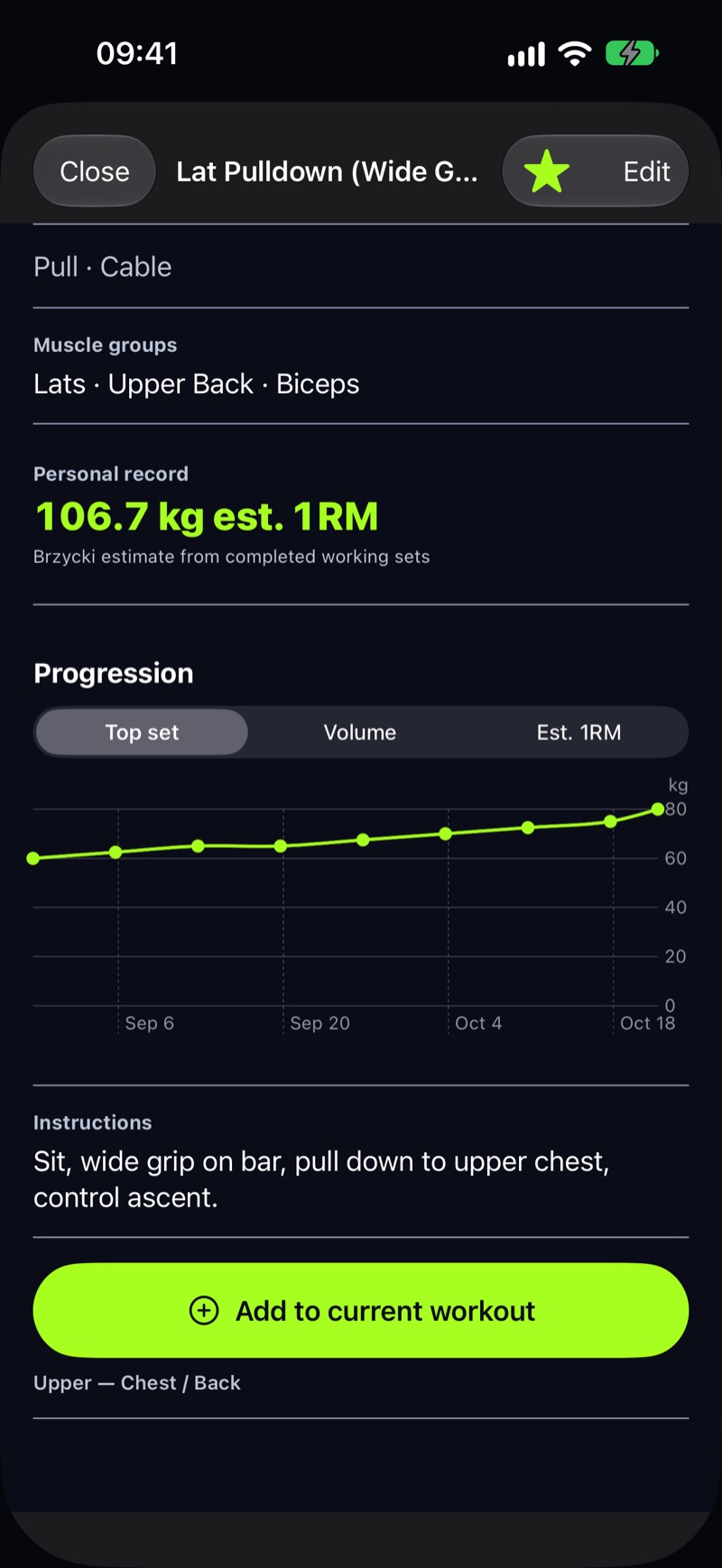
- PRs that mean something. A PR is a new best estimated 1RM (Brzycki, sets of up to 12 reps, completed working sets only). Your first session on an exercise is the baseline, not a record.
- Charts per exercise. Top set, volume and estimated 1RM over time, plus history graphs for sessions per week and training volume.
- Deload suggestion. Three sessions in a row below the bottom of the rep range at one weight pre-fill about 10 % lighter.
- Your history leaves with you. Export it as CSV, or as a full JSON backup you can restore.
Start here
- New to lifting: run a beginner gym workout plan with linear jumps, then switch to rep ranges.
- Past the beginner phase: pick a split from the programs hub and run double progression on every lift.
- Unsure about effort: use the RIR chart for a month and calibrate.
- New to logging altogether: start with how to track workouts.
Questions
What is the best way to track progressive overload?
Write down weight × reps for every working set, in order, and put last session's numbers next to today's. Beat at least one set by a rep or a small weight jump. A notebook works; an app does the lookup for you.
How do I know if I'm progressively overloading?
Look at one lift over 4–6 weeks. If you lift more weight for the same reps, or more reps at the same weight, at the same or lower effort, you are. If reps at a given weight have been flat for three sessions, you've stalled.
Can you progressive overload without adding weight?
Yes. Add reps at the same weight, add a set, or do the same work with more reps in reserve. An 8-week trial found adding reps at a fixed load built muscle about as well as adding load.
How often should progressive overload happen?
Try to beat last time on most sessions, by one rep on one set if that's all there is. Expect weight jumps every 1–2 weeks on most lifts after the beginner phase, less often on the big barbell lifts.
Should I track volume or 1RM?
Both, for different questions. Reps at a fixed weight and estimated 1RM show strength. Weekly hard sets per muscle show how much you're training. Total tonnage is the least useful; it rises with sloppy extra sets.
Sources
- ACSM 2009, Progression models in resistance training for healthy adults (position stand) pubmed.ncbi.nlm.nih.gov
- Plotkin et al. 2022, Progressive overload without progressing load? (PeerJ) pubmed.ncbi.nlm.nih.gov
- Schoenfeld et al. 2017, Dose-response of weekly training volume and muscle mass (J Sports Sci) pubmed.ncbi.nlm.nih.gov
- Zourdos et al. 2016, RPE scale measuring repetitions in reserve (J Strength Cond Res) pubmed.ncbi.nlm.nih.gov