
Key takeaways
- 01Pick a rep range, e.g. 3 × 8–12, and a weight you can lift for the bottom of it.
- 02Add reps each session. Add weight only when every working set hits the top.
- 03Add the smallest jump: 2.5 kg / 5 lb on a barbell, then restart at the bottom.
- 04Three sessions under the bottom of the range at one weight: drop about 10 % and build back.
On this page
Double progression means you keep the weight fixed and add reps until every working set reaches the top of a rep range, then add the smallest weight jump and start again at the bottom. Two things progress, reps and then load, which is where the name comes from.
It is the default progression for most lifters past their first months, because it does not need you to add weight every session. The reps carry you from one jump to the next.
The rules in one table
| Step | Rule | Example (3 × 8–12, barbell) |
|---|---|---|
| 1. Set the range | Pick sets × a rep range at least 4 reps wide | 3 × 8–12 |
| 2. Pick the start weight | A weight you can lift for the bottom of the range with 2–3 reps left | 60 kg × 8 |
| 3. Add reps | Beat last time by at least one rep on any set | 60 × 10, 9, 8 → 60 × 11, 10, 9 |
| 4. Earn the jump | Every working set hits the top of the range | 60 × 12, 12, 12 |
| 5. Add the smallest jump | 2.5 kg / 5 lb on a barbell; restart at the bottom | 62.5 × 8, 8, 8 |
| 6. Watch for stalls | Three sessions below the bottom at the same weight | 62.5 × 7, 6, 6 three times → reset about 10 % lighter |
The American College of Sports Medicine’s position stand on progression gives the same logic in one line: when you can do the current load for one to two reps over the target, increase the load by 2–10 % (ACSM 2009). Double progression makes that rule concrete: the range tells you what “over the target” means and the smallest plate tells you how big the jump is.
A worked 8-session log
A worked example run through the app’s rules. Bench press, 3 × 8–12, twice a week, kilograms, standard plates down to 1.25 kg. The “pre-filled” column is what the app puts in the boxes before the session: last time’s numbers to beat, or the new weight once it’s earned. Volume is weight × total reps. Est. 1RM is the Brzycki estimate from the best set.
| Session | Pre-filled | Logged | Reps | Volume | Est. 1RM |
|---|---|---|---|---|---|
| W1 Mon | 60 × 8, 8, 8 (routine target) | 60 × 10, 9, 8 | 27 | 1,620 kg | 80.0 kg |
| W1 Thu | 60 × 10, 9, 8 | 60 × 11, 10, 9 | 30 | 1,800 kg | 83.1 kg |
| W2 Mon | 60 × 11, 10, 9 | 60 × 12, 11, 10 | 33 | 1,980 kg | 86.4 kg |
| W2 Thu | 60 × 12, 11, 10 | 60 × 12, 12, 11 | 35 | 2,100 kg | 86.4 kg |
| W3 Mon | 60 × 12, 12, 11 | 60 × 12, 12, 12 | 36 | 2,160 kg | 86.4 kg |
| W3 Thu | 62.5 × 8, 8, 8 | 62.5 × 9, 8, 8 | 25 | 1,562.5 kg | 80.4 kg |
| W4 Mon | 62.5 × 9, 8, 8 | 62.5 × 10, 9, 8 | 27 | 1,687.5 kg | 83.3 kg |
| W4 Thu | 62.5 × 10, 9, 8 | 62.5 × 11, 10, 9 | 30 | 1,875 kg | 86.5 kg |
Three things to read from it:
- Volume and estimated 1RM dip the day you add weight. W3 Thu has fewer reps than W3 Mon. That is the method working, not a bad session. Judge the block by the reps at a given weight.
- The last set is the bottleneck. Set 3 reached 12 one session after set 1. That’s normal, and it’s why the rule waits for every set.
- Five sessions per 2.5 kg is a typical pace for an intermediate bench. Fewer sessions means the range or the jump is too easy. Ten or more means it is too hard; see the stall section below.
Choosing the rep range
| Exercise type | Range | Jump | Why |
|---|---|---|---|
| Squat, bench, deadlift, overhead press | 5–8 or 6–10 | 2.5 kg / 5 lb | Heavy enough to drive strength; reps stay countable |
| Rows, presses, leg press, pulldowns | 8–12 | 2.5 kg / 5 lb, or one pin | The classic double-progression range |
| Dumbbell presses and rows | 8–12 or 10–15 | 2 kg / 5 lb per dumbbell | Dumbbell jumps are large in percentage terms |
| Lateral raises, curls, calves, face pulls | 12–20 | Smallest dumbbell or pin | Small muscles, big relative jumps; wide range absorbs them |
A narrow range such as 8–9 is a trap: you get one rep of progress before every weight jump, and the jump is often bigger than one rep can pay for. Keep the range 4 reps wide or more.
Does it matter whether the progress comes from reps or load? For muscle growth, not much. In an 8-week trial with trained lifters, one group added load at fixed reps and the other added reps at a fixed load; hypertrophy and strength came out close, with a small strength edge for the load group (Plotkin et al. 2022). Double progression uses both.
When the jump is too big
The smallest jump on a barbell is about 2.5 % of a 100 kg bench. On an 8 kg dumbbell lateral raise, the next dumbbell is 10 kg: a 25 % jump. Going from 8 kg × 20 to 10 kg × 12 rarely works.
The fix is an extended ceiling. Keep adding reps past the top of the range, then take the jump:
| Session | Lateral raise, 3 × 12–20 | Next |
|---|---|---|
| 1 | 8 kg × 20, 20, 20 | Jump too big (25 %): keep the weight, add a rep |
| 2 | 8 kg × 21, 21, 21 | One more rep per session |
| 3–4 | 8 kg × 22 … 23 | Keep going |
| 5 | 8 kg × 24, 24, 24 | Ceiling reached |
| 6 | 10 kg × 12, 12, 12 | New weight, bottom of the range |
LiftLoggr uses this rule for any lift where one step is more than 10 % of the load. The ceiling is the top of the range plus half the range width, and at least 2 reps more (24 for 12–20, 14 for 8–12).
Using reps in reserve to move faster
Reps in reserve (RIR) is how many more reps you could have done when you stopped the set (Zourdos et al. 2016). It catches two cases the rep count alone misses:
- The range was too easy. If every set hits 12 with 3 or more reps left, one 2.5 kg jump is too small. Take two.
- A “stall” that wasn’t. A session where you stayed under the range but stopped with 2 reps left was a choice, not a failure. It shouldn’t count toward a deload.
Stopping 1–3 reps short of failure is enough for both goals. A 2024 meta-regression found strength gains were similar across a wide range of RIR, while muscle growth improved as sets ended closer to failure (Robinson et al. 2024). For double progression that means: work hard on the last set, and don’t grind every set to zero. More in RIR vs RPE and the RIR chart.
When it stalls
A stall is not one bad day. Use this:
| What the log shows | What it means | Do this |
|---|---|---|
| Reps flat for 2 sessions, still inside the range | Normal grind | Keep going; check sleep and rest times |
| Below the bottom of the range for 3 sessions at one weight | Real stall | Drop about 10 %, restart at the bottom, build back |
| Stalled on most lifts at once | Accumulated fatigue | Take a deload week |
| Never stalls, adds weight every 1–2 sessions | Range or jump too easy | Narrow the jump or raise the bottom of the range |
The 10 % reset works because you rebuild through the range with better technique and usually pass the old best within a few weeks.
Mistakes that break double progression
- Adding weight off one set. Set 1 at 12, sets 2 and 3 at 9: not yet.
- Changing the exercise mid-block. A different bench angle or grip is a different lift. Start a new progression.
- Counting sloppy reps. If depth or range of motion shrinks, the extra rep didn’t happen.
- Shortening rest to fit the session. Reps drop and the log lies. Keep rest consistent: see rest between sets.
- Not writing it down. Double progression needs last session’s reps per set. Memory doesn’t hold three numbers per exercise for five exercises. Log it in a notebook, a sheet or an app.
How LiftLoggr runs it
LiftLoggr applies these rules on its own, for every exercise that has a rep range in its routine (for example “3 × 8–12”).
- Last time beside each set. Each set row shows last session’s weight × reps for the same set.
- Pre-filled targets. A new session starts with last time’s numbers. When every working set hit the top of the range, the weight goes up one step and the reps reset to the bottom.
- The step follows the equipment. 2 × your smallest plate on a barbell (2.5 kg with 1.25 kg plates, 5 lb with 2.5 lb plates), 2 kg / 5 lb per dumbbell, 2.5 kg / 5 lb on a machine or cable.
- Too-big jumps. When one step is more than 10 % of the load, reps climb to the extended ceiling first.
- RIR, if you log it. Turn on Settings → Logging → Log reps in reserve. Every last-session set at the top with RIR 3 or more pre-fills two steps instead of one. A strong first set (2+ reps over the top, or at the top with RIR 3+) shows a “Go 62.5 kg for the rest” chip for the remaining sets.
- Deload suggestion. Three sessions in a row below the bottom of the range at the same top weight pre-fill about 10 % lighter, rounded to loadable plates, at the bottom of the range. A session whose best set at that weight ended with RIR 2 or more doesn’t count as a stall.
- Warm-ups and drop sets never progress. They copy last time’s.
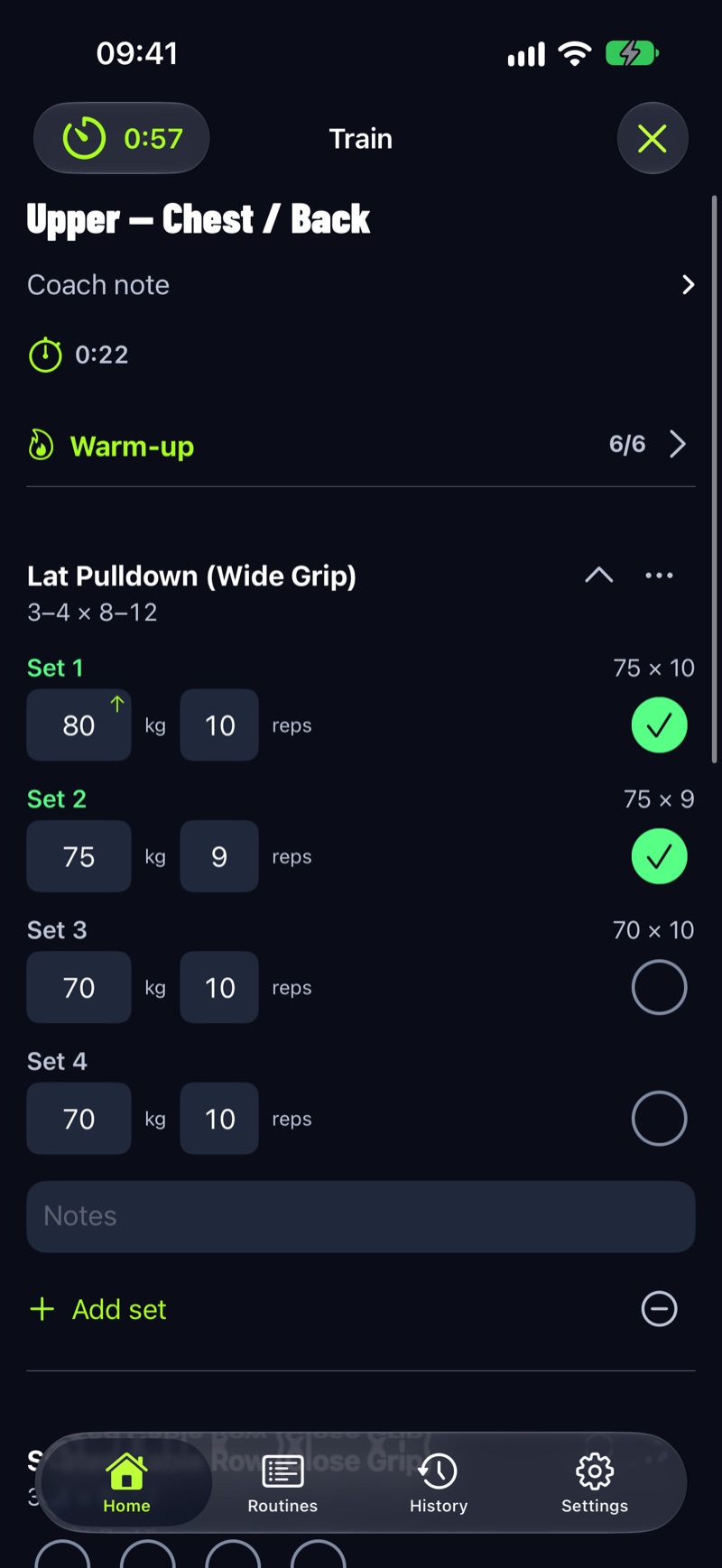
AMRAP, max-rep and timed sets never auto-progress. You can always overwrite a pre-fill; the app only suggests.
Double vs linear progression
| Linear progression | Double progression | |
|---|---|---|
| Rule | Add weight every session | Add reps, then weight |
| Best for | First 2–6 months of lifting | Everyone after that |
| Stalls when | The jump outpaces recovery | Reps stop climbing for 3 sessions |
| Fixes for a stall | Smaller plates, reset | Reset 10 %, wider range, or deload |
Most beginner programs run linear progression on the big lifts until it stops working, then switch. The beginner gym workout plan and the push pull legs program both use rep ranges built for double progression. To see the whole picture of tracking overload, read the pillar guide: how to track progressive overload.
Questions
How many reps before I increase the weight?
When every working set reaches the top of your rep range with clean form. With 3 × 8–12, that means 12, 12 and 12. One set at 12 is not enough.
Is double progression better than linear progression?
Not better, longer-lasting. Linear progression adds weight every session and works for a beginner's first months. Double progression lets reps absorb the gap between weight jumps, so it keeps working when adding 2.5 kg every session no longer does.
What rep range should I use for double progression?
Give the range at least 4 reps of width. 5–8 or 6–10 for big barbell lifts, 8–12 for most compound and machine work, 12–20 for small muscles such as lateral raises and calves.
Do all sets have to hit the top of the range?
In the strict version, yes. It stops you adding weight off one good first set. A looser version moves up when the first set hits the top, but then later sets often fall below the bottom of the range.
What if the weight jump is too big?
On light dumbbells or cable stacks one jump can be 20 % or more of the load. Push the reps 2–4 past the top of the range first, then take the jump. LiftLoggr does this automatically when one step is more than 10 % of the load.
Sources
- Plotkin et al. 2022, Progressive overload without progressing load? (PeerJ) pubmed.ncbi.nlm.nih.gov
- ACSM 2009, Progression models in resistance training for healthy adults (position stand) pubmed.ncbi.nlm.nih.gov
- Zourdos et al. 2016, RPE scale measuring repetitions in reserve (J Strength Cond Res) pubmed.ncbi.nlm.nih.gov
- Robinson et al. 2024, Proximity to failure, strength and hypertrophy: meta-regressions (Sports Med) pubmed.ncbi.nlm.nih.gov