
Key takeaways
- 01Every working set: exercise, weight, reps, and how many reps you had left.
- 02Read last time before each set. Beat it by one rep or one small plate.
- 03Warm-ups and notes are optional. Consistent units and exercise names are not.
- 04Review once a week: which lifts moved, which stalled for three sessions.
On this page
To track workouts, write down four things for every working set: the exercise, the weight, the reps, and how many reps you had left in the tank. Before each set, read what you did last time and try to beat it by one rep or one small plate.
That is the whole method. Everything else in this guide is about making those four numbers easy to record, easy to read mid-session, and honest enough to act on.
Why track at all
Strength comes from doing slightly more over time. The American College of Sports Medicine’s position stand on resistance training builds its progression models on that principle: progressive overload, specificity and variation. You can’t apply progressive overload to a number you don’t remember.
Memory fails in predictable ways. You remember your best set, not your typical one. You remember the weight, not the reps. You forget that last week’s 80 kg felt like a grind. A log fixes all three.
The four numbers
| Field | Example | Why it matters |
|---|---|---|
| Exercise | Barbell Bench Press | Use one exact name forever. “Bench” and “flat bench” become two histories. |
| Weight | 80 kg | Always with the unit. Total load on the bar, not plates per side. |
| Reps | 8 | Reps you completed with good form. A half rep is not a rep. |
| Reps in reserve (RIR) | 2 | How many more clean reps you could have done. Separates an easy 8 from a grinder. |
RIR is the one most people skip, and it’s the one that tells you whether to add weight. Zourdos et al. (2016) showed lifters can estimate reps in reserve with reasonable accuracy, and accuracy improves the closer the set is to failure. See RIR vs RPE for the scale.
What a useful log looks like
One session, written so that next week’s numbers fall straight out of it:
| Exercise | Set | Weight | Reps | RIR | Note |
|---|---|---|---|---|---|
| Barbell Back Squat (High Bar) | 1 | 100 kg | 8 | 2 | |
| 2 | 100 kg | 8 | 1 | ||
| 3 | 100 kg | 7 | 0 | Depth slipped on rep 7 | |
| Romanian Deadlift (RDL) | 1 | 90 kg | 10 | 2 | Straps |
| 2 | 90 kg | 10 | 1 | ||
| Leg Press | 1 | 180 kg | 12 | 2 | Seat 5 |
| 2 | 180 kg | 12 | 1 | ||
| 3 | 180 kg | 12 | 1 | Top of range on all sets |
Read it like a coach would:
- Squat, 3 × 6–8: two sets at 8, one at 7 with 0 RIR. Stay at 100 kg next time and get the third set to 8.
- RDL, 2 × 8–10: both sets at the top of the range with reps to spare. Add 2.5 kg.
- Leg press, 3 × 10–12: every set at 12. Add a step next session. The seat setting goes with it.
That decision rule is double progression: work up a rep range, then add weight when every set hits the top.
What to track and what to skip
| Track | Skip, or track only if it changes a decision |
|---|---|
| Exercise, weight, reps, RIR for every working set | Exact rest times (keep them consistent instead) |
| Machine settings: seat, pin, handle | Calories burned during lifting |
| Pain, form breakdowns, equipment swaps | A mood score for every session |
| The date, and what routine you ran | Sets you didn’t do as planned (leave them blank, not zero) |
| Warm-ups, if you want them in your volume | Every warm-up mobility drill |
More on notes in what to write in a workout journal.
Pick a tool you’ll actually open
Any medium works if it shows you last time before you lift.
| Tool | Last time visible? | Does the maths? | Survives a lost phone? | Best for |
|---|---|---|---|---|
| Paper notebook | Flip back a page | No | If you don’t lose the book | Lifters who want zero screen time |
| Notes app | Scroll up | No | With the phone’s cloud backup | A first month, a travel week |
| Spreadsheet | Yes, with formulas | Yes, if you build it | Yes | Lifters who like building charts |
| Workout app | Beside each set | Usually | Depends on its export and backup | Most lifters training 3+ days a week |
The trade-offs are covered in gym notebook vs app. If you want paper, start from the printable workout log.
How to track workouts in LiftLoggr
This is how the app handles the four numbers, as it works today on iPhone and Apple Watch.
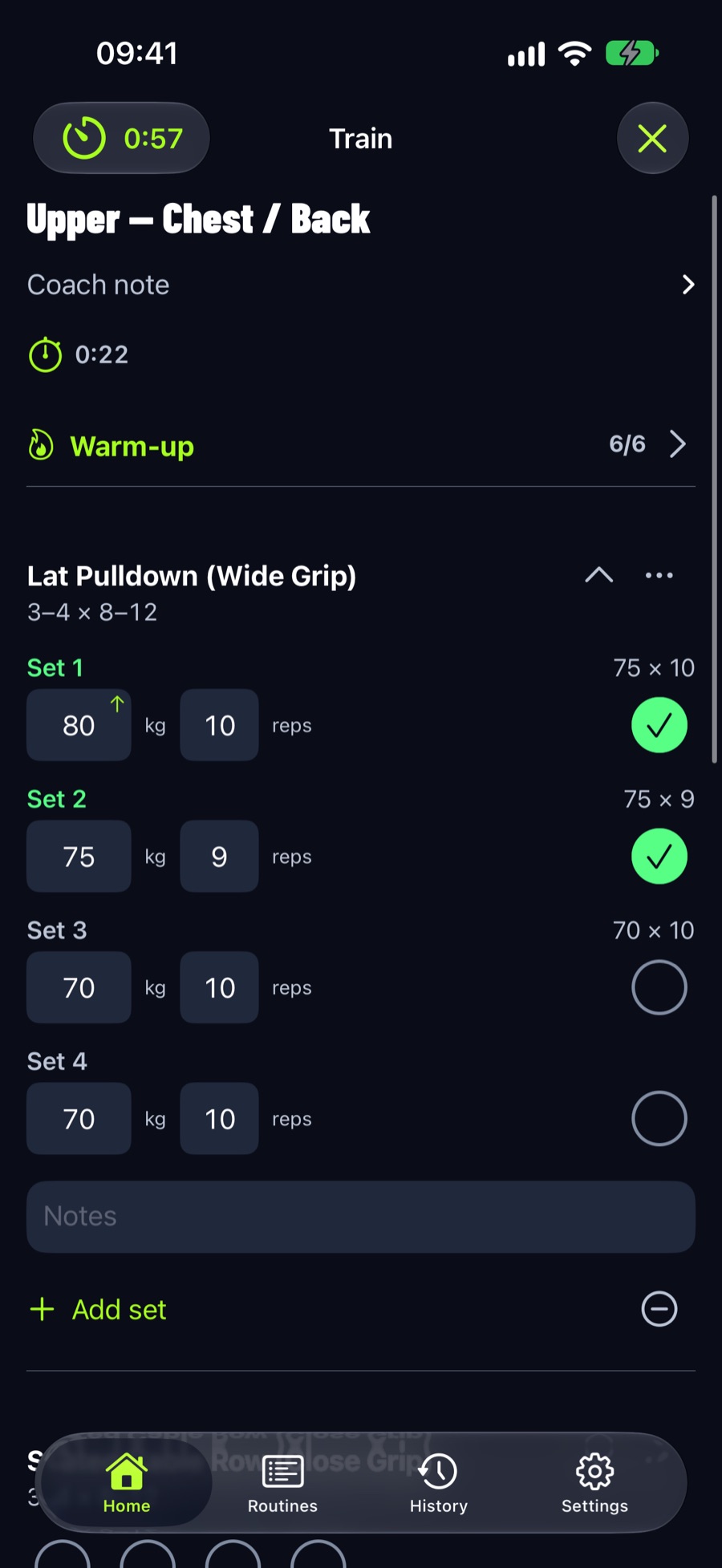
- Last time beside every set. Each set shows the weight × reps you did on the same set last session, so you never scroll back.
- Next weights pre-filled. With a rep range set on the routine, a new session pre-fills from last time. When every working set hit the top of the range, the weight goes up one step: two of your smallest plates on a barbell, 2 kg on dumbbells. Three sessions in a row below the floor at the same top load suggest a deload of about 10%.
- One tap per set. Enter or adjust the numbers, tap the circle. The rest timer starts on its own, and shows on the Lock Screen, the Dynamic Island and the Apple Watch.
- RIR when you want it. Turn on Settings → Log reps in reserve and a “Reps left 0 1 2 3 4+” row appears after each working set. One tap logs it. Logged RIR refines the progression: when the last working sets finish at the top of the range with 3 or more reps left, the next weight goes up two steps instead of one.
- Notes per exercise. A notes field sits under each exercise for seat settings, grip and pain.
- The record keeps itself. Personal records, estimated 1RM (Brzycki formula, sets up to 12 reps, warm-ups excluded), strength and volume charts, a training calendar and a weekly streak.
No account and no LiftLoggr server: your workouts stay on your device, with optional iCloud sync to your own private iCloud and a full export whenever you want it.
The weekly review: ten minutes that pays for the log
Once a week, look at the main lift of each day and answer three questions:
- Did it move? More reps at the same weight or more weight at the same reps. Either counts.
- Is anything stuck? Three sessions at the same weight, below the bottom of the rep range, is a stall. Drop 10% and build back, or change the rep range. See deload week.
- Is the effort honest? If every set is logged at 3+ RIR and nothing hurts, you have room to push. If everything is 0 RIR and reps are falling, recover first.
A worked week, squat only:
| Week | Session | Sets × reps at 100 kg | Read |
|---|---|---|---|
| 1 | Mon | 8, 8, 7 | Hold weight |
| 1 | Thu | 8, 8, 8 | Top of range: add 2.5 kg |
| 2 | Mon | 102.5 kg: 7, 7, 6 | Normal dip after a jump |
| 2 | Thu | 102.5 kg: 8, 7, 7 | Climbing. Hold weight |
That table took four lines to log and makes the next two weeks obvious. That is what tracking is for.
Mistakes that make a log useless
- Logging only your best set. Log every working set. The third set tells you more about fatigue than the first.
- Changing exercise names. “DB press”, “dumbbell bench” and “flat DB” split one history into three. Pick a name, or use the app’s exercise library so the name never drifts.
- Mixing units. A log that says “100” with no unit is useless the day you train in another gym.
- Rounding up. Seven reps and a grind is seven reps at 0 RIR, not eight.
- Never looking back. A log you don’t read before the set is a diary, not a training tool.
- Tracking everything. If a field never changes what you lift next, drop it. The four numbers are enough for years.
Where to go next
- What to write in a workout journal: templates and note examples.
- Gym notebook vs app: a fair comparison, including when paper wins.
- How to track progressive overload: turning the log into next week’s weights.
- Printable workout log: kg and lb versions.
Questions
What is the easiest way to track workouts?
Log four things for every working set: exercise, weight, reps and reps in reserve. Paper, a notes app or a workout app all work. The easiest method is the one that shows you last time's numbers before you start the set.
Should I track every set, including warm-ups?
Track every working set. Warm-ups are optional: log them if you want them in your volume, or let the app build them from your first working set. Never mix them into your working sets without marking them.
Should I track my workouts as a beginner?
Yes. Beginners progress fastest, so they have the most to lose from guessing. A log stops you repeating the same weight for a month or jumping too far on a good day.
How do I know if I'm progressing?
Compare the same exercise at the same rep range across sessions. More reps at the same weight, or the same reps at a heavier weight, is progress. Three sessions in a row below your rep target at the same weight is a stall.
Do I need to track rest times?
Not in the log. Keep rests consistent so sessions compare fairly, and let a timer handle it. A rest timer that starts when you check a set is the simplest way.