
Key takeaways
- 01Can't do one yet: Lat Pulldown plus Negative Pull-Ups.
- 02No bar at home: Resistance Band Lat Pulldown and Inverted Rows.
- 03Elbows complain: neutral grip, on the bar or the pulldown.
- 04Assisted machine: the number is help. Less is progress, even if the app reads it as load.
On this page
The best pull-up alternative is the lat pulldown: same vertical pull, adjustable load, small steps. If you’re working toward your first pull-up, pair it with Negative Pull-Ups or Band-Assisted Pull-Ups. Without a bar at home, use a Resistance Band Lat Pulldown and Inverted Rows.
The pull-up is a strange lift. The load is your body weight, so a beginner may not be able to do a single rep, and an advanced lifter needs a belt and plates to keep it hard. Alternatives solve one of three problems: too heavy, nowhere to hang, or something hurts.
The alternatives, by situation
All names match the LiftLoggr exercise library.
| Situation | Exercise (LiftLoggr name) | Why it works |
|---|---|---|
| Can’t do one yet | Lat Pulldown (Wide Grip) | Same pull, any load below body weight. Highest lat-to-biceps ratio of four lat exercises in Lehman 2004. |
| Can’t do one yet | Negative Pull-Up | Jump or step to the top, lower for 3–5 seconds. Practises the real movement. |
| Can’t do one yet | Band-Assisted Pull-Up | Real bar, real path. Use a thinner band as you get stronger. |
| Can’t do one yet | Assisted Pull-Up Machine | Assistance set in exact steps. Read the logging note below. |
| No bar, home | Resistance Band Lat Pulldown | Anchor a band high, kneel and pull. |
| No bar, home | Inverted Row / Bodyweight Row | Horizontal, not vertical, but trains the same lats and upper back with body weight. |
| No bar, home | Dumbbell Single Arm Row | Heavy lat work with a dumbbell and a bench. |
| Elbows or shoulders | Neutral Grip Pull-Up | Palms facing; often the most comfortable grip. |
| Elbows or shoulders | Lat Pulldown (Neutral Grip) | Neutral grip with a lighter load. |
| Machine gym | Machine High Row | Pulls from high and in front: between a pulldown and a row, on a fixed path. |
| Lats only | Straight Arm Pulldown | Takes the biceps out. Good as a second lat exercise. |
| Too easy | Weighted Pull-Up | Add a belt, a plate or a dumbbell between the feet. |
What the research says
What a pull-up trains. Youdas et al. (2010) measured muscle activity in pull-ups and chin-ups. Latissimus dorsi activity was 117 to 130% of a maximal isometric contraction, biceps 78 to 96%. The chin-up used more pectoralis major and biceps; the pull-up used more lower trapezius. Both started with the lower traps and pecs and finished with the lats and biceps.
Grip on the pulldown. Lusk et al. (2010) compared wide and narrow, overhand and underhand grips at 70% of 1RM. An overhand grip produced more lat activity than an underhand one at both widths. Width made no difference. Lehman et al. (2004) found the highest lat-to-biceps ratio in the wide-grip pulldown and the seated row.
Pulldown vs pull-up. Doma et al. (2013) found chin-ups used more biceps and lower-back muscle activity than lat pulldowns, with more shoulder movement. Johnson et al. (2009) found men’s lat-pull and pull-up 1RM correlated well (r = 0.78), while women’s did not reach significance (r = 0.44). Men’s lat-pull 1RM was about 80% of their pull-up 1RM (body weight plus added load).
So pulldowns build the muscles. The pull-up skill comes from pulling your own body: negatives, bands and partial reps on the bar.
How to swap without losing progress
- Pull-ups to pulldowns. Keep the rep range. Start well under your body weight, since pulldown loads run about 80% of a full pull-up’s load and machines differ. Find the weight that leaves 2–3 reps in reserve.
- Pulldowns back to pull-ups. Count total reps across sets. Three sets of 3 is 9 reps; aim to beat that number each week before adding sets.
- Weighted pull-ups. Log only the added weight, and keep that convention.
- Keep them separate. Pulldown records aren’t pull-up records.
In LiftLoggr
Open the exercise’s menu, tap Swap exercise… and choose from Suggested or search. For Pull-Up (Overhand Grip), the first suggestions are Negative Pull-Up, Neutral Grip Pull-Up and Weighted Pull-Up, with assisted options and pulldowns next.
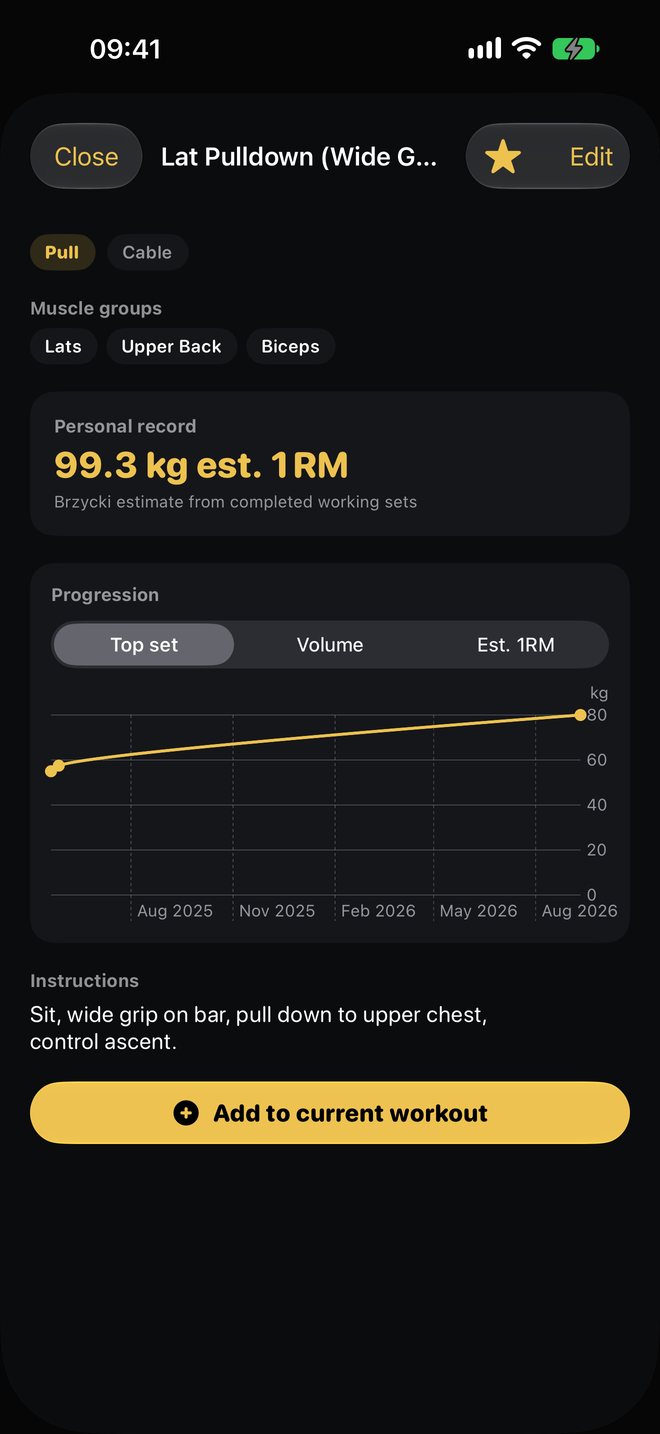
How pull-ups are logged decides what the app can show you:
- Bodyweight pull-ups with no weight logged progress by reps. “Last time” shows your previous reps beside each set. Estimated 1RM and PR flags need a logged weight, so they start once you add load.
- Weighted Pull-Up is its own exercise. Log the added weight; records and estimated 1RM then use it.
- Lat Pulldown is a cable exercise: double progression adds 2.5 kg (5 lb) when every working set hits the top of the range.
- Assisted Pull-Up Machine: the stack number is assistance, but the app treats it as load like any other machine. More assistance can show as a PR, and hitting the top of the range suggests a heavier number. On this one exercise, ignore both and lower the assistance yourself.
The swap changes today’s session only. On the summary, Routine changed lists it with Update routine and Keep original.
Mistakes to avoid
- Only doing pulldowns and expecting a pull-up. Add negatives or band-assisted reps twice a week.
- Kipping before strict reps. Get several clean, strict reps first.
- Pulling the bar behind the neck. Pull in front, to the upper chest.
Rows are the other half of back training: see barbell row alternatives. For how many back sets to do a week, read sets per muscle per week; for a split that trains vertical pulls twice a week, see upper/lower.
Questions
What is the best alternative to pull-ups?
The lat pulldown. It's the same vertical pull, you can set the load below your body weight, and it progresses in small steps. Pronated (overhand) grips gave more lat activity than underhand grips at any width in Lusk 2010.
Does the lat pulldown build pull-up strength?
Partly. In Johnson 2009, lat-pull and pull-up 1RM correlated well in men (r = 0.78) but not significantly in women (r = 0.44). Chin-ups also used more biceps and trunk than pulldowns in Doma 2013. Pair pulldowns with negatives or assisted pull-ups to practise the real movement.
How do I train pull-ups at home without a bar?
Use a band anchored high for Resistance Band Lat Pulldowns, and rows under a sturdy table or a bar in a rack for Inverted Rows. A doorway pull-up bar is the cheapest real fix.
How do I log assisted pull-ups?
Log the assistance shown on the stack and keep it consistent. Progress means the number going down. LiftLoggr treats that number as load like any machine, so on the assisted machine ignore its PR flag and progression suggestion, and lower the assistance yourself when you hit the top of your rep range.
Sources
- Youdas et al. 2010, EMG during pull-up, chin-up and rotational pull-up (J Strength Cond Res) pubmed.ncbi.nlm.nih.gov
- Doma et al. 2013, chin-ups vs lat pull-down: kinematics and EMG (Sports Biomech) pubmed.ncbi.nlm.nih.gov
- Johnson et al. 2009, lat-pull and pull-up repetitions vs maximal strength (J Strength Cond Res) pubmed.ncbi.nlm.nih.gov
- Lusk et al. 2010, grip width and forearm orientation in the lat pull-down (J Strength Cond Res) pubmed.ncbi.nlm.nih.gov
- Lehman et al. 2004, muscle activation in traditional latissimus dorsi exercises (Dyn Med) pubmed.ncbi.nlm.nih.gov