
Key takeaways
- 01Upper A, Lower A, rest, Upper B, Lower B: 4 sessions, every muscle 2× a week.
- 025–6 exercises a session, 3 sets each, about 55–65 minutes.
- 03Add 2.5 kg (5 lb) once every working set reaches the top of its rep range.
- 04Deload every 8th week, or earlier when a lift stalls three sessions running.
On this page
- Days per week
- 4
- Level
- Intermediate
- Length
- 8 weeks
- Equipment
- Barbell, dumbbells, adjustable bench, cable station, pull-up bar, leg press, leg extension, leg curl and calf machines
A .liftloggr.json routine file. Open it on your iPhone and choose LiftLoggr to import every day of the plan.
The schedule
Day 1 Upper A
| Exercise | Sets | Reps | RIR |
|---|---|---|---|
| Barbell Bench Press | 3 | 6-10 | 2 |
| Barbell Bent Over Row | 3 | 6-10 | 2 |
| Dumbbell Overhead Press (Seated) | 3 | 8-12 | 2 |
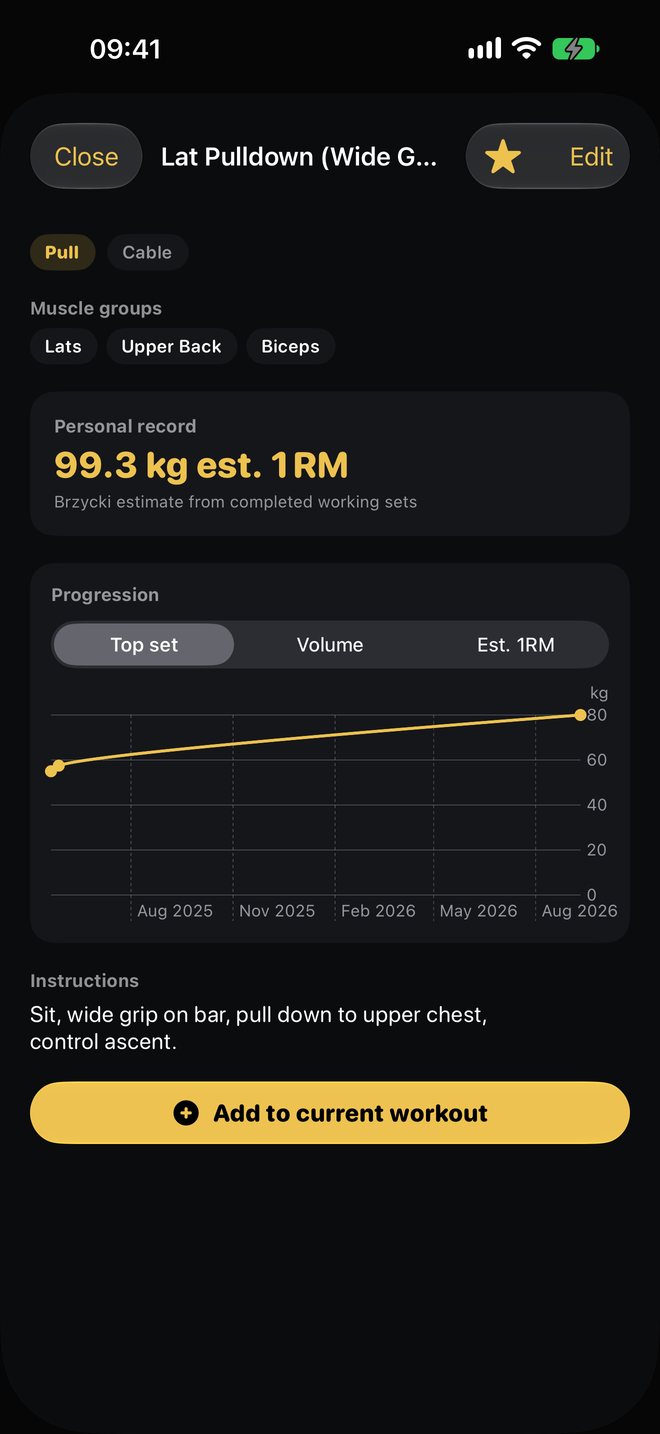
| Lat Pulldown (Wide Grip) | 3 | 8-12 | 2 |
| Dumbbell Lateral Raise | 3 | 12-20 | 1 |
| Cable Triceps Pushdown (Rope) | 3 | 10-15 | 1 |
Day 2 Lower A
| Exercise | Sets | Reps | RIR |
|---|---|---|---|
| Barbell Back Squat (High Bar) | 3 | 6-10 | 2 |
| Romanian Deadlift (RDL) | 3 | 8-12 | 2 |
| Leg Extension | 3 | 10-15 | 1 |
| Lying Leg Curl | 3 | 10-15 | 1 |
| Standing Calf Raise | 3 | 10-20 | 1 |
Day 3 Upper B
| Exercise | Sets | Reps | RIR | Notes |
|---|---|---|---|---|
| Incline Dumbbell Bench Press | 3 | 8-12 | 2 | |
| Seated Cable Row (Close Grip) | 3 | 8-12 | 2 | |
| Barbell Overhead Press (Strict) | 3 | 6-10 | 2 | |
| Pull-Up (Overhand Grip) | 3 | 6-10 | 2 | Add load once all 3 sets reach 10 |
| Face Pull | 3 | 12-20 | 1 | |
| Dumbbell Bicep Curl (Standing) | 3 | 8-12 | 1 |
Day 4 Lower B
| Exercise | Sets | Reps | RIR | Notes |
|---|---|---|---|---|
| Leg Press | 3 | 8-12 | 2 | |
| Barbell Hip Thrust | 3 | 8-12 | 2 | |
| Bulgarian Split Squat | 3 | 8-12 | 2 | Reps per leg |
| Seated Leg Curl | 3 | 10-15 | 1 | |
| Seated Calf Raise | 3 | 10-20 | 1 |
Progression
Double progression on every exercise. Keep the weight until all three working sets reach the top of the rep range with clean reps and 1–2 reps in reserve, then add one step: 2.5 kg (5 lb) on barbell and machine lifts, the next dumbbell on dumbbell work. Climb the reps again from wherever they land. Pull-ups progress by reps, then by added load.
Deload
Every 8th week, run a deload: same exercises, 2 sets instead of 3, about 10% lighter, 3–4 reps in reserve. Deload early if a lift misses the bottom of its range three sessions in a row at the same weight. Resume at your pre-deload weights.
An upper lower split trains the upper body on two days and the lower body on two days, so every muscle gets worked twice a week in four sessions. Run Upper A, Lower A, a rest day, Upper B, Lower B, and add weight whenever every set reaches the top of its rep range.
This is the same four-day program as LiftLoggr’s Upper / Lower starter split, the default a new install offers on first launch. Below: the schedule, how to structure each day, the load rule with a worked log, weekly volume per muscle, deloads, substitutions and the routine file.
The weekly schedule
| Day | Session | Focus |
|---|---|---|
| Mon | Upper A | Horizontal press and row first |
| Tue | Lower A | Squat and hinge |
| Wed | Rest | — |
| Thu | Upper B | Vertical press and pull-up first |
| Fri | Lower B | Leg press, hip thrust, single-leg work |
| Sat | Rest | — |
| Sun | Rest | — |
Monday/Tuesday/Thursday/Friday is the classic layout: never more than two training days in a row. Monday/Wednesday/Friday/Saturday also works. What matters is the order: A before B, upper before lower, so neither half gets trained two days running.
How each day is built
Every session follows the same shape. That is the answer to “how to structure an upper lower split”:
- Two heavy compounds at 6–10 reps (8–12 for dumbbells), 2–3 minutes rest. On upper days, one push and one pull. On lower days, one squat pattern and one hinge.
- One or two secondary compounds at 8–12 reps.
- Isolation work at 10–15 or 12–20 reps, 60–90 seconds rest: lateral raises, face pulls, curls, pushdowns, leg curls, calves.
The A and B days use different exercises for the same muscles. Upper A presses horizontally first (bench), Upper B vertically (overhead press). Lower A is squat and Romanian deadlift; Lower B is leg press, hip thrust and Bulgarian split squats. Two movement patterns per muscle per week cover more of each muscle and spread joint stress.
Effort. Target 2 reps in reserve on compounds and 1 on isolation work. You stop each set when you could do one or two more clean reps. See RIR vs RPE if RIR is new.
Warm-ups. 2–4 ramp-up sets before the first lift of each day. The warm-up calculator builds them from your working weight.
Load and progression
Double progression: the weight stays put while reps climb, then the weight goes up and the reps reset.
- Start each exercise at a weight you can lift for the bottom of the range with 2 reps in reserve.
- Add reps session to session at that weight.
- When all three working sets reach the top of the range, add one step: 2.5 kg (5 lb) on barbells and machines, the next dumbbell on dumbbell lifts.
- Keep climbing from wherever the reps land.
This matches the ACSM position stand on progression: increase load by 2–10% once you can do one or two reps over the target.
A worked four-week example
Barbell overhead press on Upper B, 3 × 6–10, logged in pounds:
| Week | Weight | Set 1 | Set 2 | Set 3 | Decision |
|---|---|---|---|---|---|
| 1 | 95 lb | 8 | 7 | 7 | Stay |
| 2 | 95 lb | 9 | 8 | 8 | Stay |
| 3 | 95 lb | 10 | 10 | 9 | Stay: set 3 missed the top |
| 4 | 95 lb | 10 | 10 | 10 | All at the top: 100 lb next week |
Four weeks at one weight is normal for the overhead press: 5 lb is more than 5% of 95 lb. Squats, leg presses and hip thrusts usually move faster. Full method in double progression.
Weekly volume per muscle
Direct working sets per week. Compound lifts also train the muscles in the third column.
| Muscle | Direct sets / week | Also trained by |
|---|---|---|
| Chest | 6 | Overhead presses |
| Back (lats, mid-back) | 12 | Romanian deadlift (upper back holds the bar) |
| Shoulders, front | 6 | Bench and incline press |
| Shoulders, side | 3 | Both overhead presses |
| Shoulders, rear | 3 | All four rows and pulls |
| Biceps | 3 | All four rows and pulls |
| Triceps | 3 | All four presses |
| Quads | 12 | — |
| Hamstrings | 9 | Hip thrust |
| Glutes | 3 | Squat, RDL, leg press, split squat |
| Calves | 6 | — |
The program is deliberately lean on chest, side delts and arms: 6 or fewer direct sets. That keeps sessions near an hour. Schoenfeld’s 2017 meta-analysis found more weekly sets produced more growth, so if one of those muscles is a priority, add sets there first: a fourth set on the incline press, a cable fly on Upper A, a set of curls and pushdowns on each upper day. Check the total with the weekly volume calculator and the ranges in sets per muscle per week.
Deload rule
Seven hard weeks, then one deload week: same exercises, 2 sets instead of 3, about 10% less weight, 3–4 reps in reserve. A 2023 Delphi consensus of strength and physique coaches describes a deload as a period of reduced training stress to manage fatigue and prepare for the next block.
Deload early when a lift misses the bottom of its rep range three sessions in a row at the same weight, or when joints ache before you start. Afterwards, go back to your pre-deload weights. More in the deload week guide.
Substitutions
Keep the movement pattern and rep range when you swap.
| Planned | Swap for | Guide |
|---|---|---|
| Barbell bench press | Dumbbell bench press, machine chest press | Bench press alternatives |
| Barbell overhead press | Seated dumbbell press, machine shoulder press | Overhead press alternatives |
| Barbell back squat | Hack squat, Smith machine squat, goblet squat | Squat alternatives |
| Romanian deadlift | Dumbbell RDL, back extension | Deadlift alternatives |
| Pull-up | Lat pulldown (neutral grip), assisted pull-up | Pull-up alternatives |
| Barbell row | Chest-supported dumbbell row, seated machine row | Barbell row alternatives |
A new exercise starts a new history. Begin conservatively and let double progression find the right weight within two or three sessions.
Common mistakes
- Training upper and lower on the same muscles twice in a row. Run A then B. Back-to-back Upper A sessions make the B exercises disappear.
- Running out of time and cutting the last exercise every week. Calves and leg curls are what usually goes. Cut a warm-up set instead, or superset the last two exercises.
- Adding weight on two out of three sets. All three sets at the top, then add. The third set is where the progress shows.
- Ego reps on the hip thrust and leg press. Partial reps make the log lie. Use a full range and a pause where the program asks for control.
- Changing the plan every four weeks. Same exercises, heavier weights. That is the program.
- No log. You can’t apply double progression from memory across 22 exercises. See how to track progressive overload.
Upper/lower vs PPL vs full body
| Days you can train | Best fit | Each muscle trained |
|---|---|---|
| 3 | Full body 3-day | 2–3× a week |
| 4 | Upper/lower (this page) | 2× a week |
| 5–6 | Push pull legs | 2× a week on 6 days |
A 2019 meta-analysis by Schoenfeld, Grgic and Krieger found no meaningful difference in muscle growth between training frequencies once weekly volume was equal, and Grgic et al. (2018) found the same for strength. The split you can follow for months beats the theoretically better one. For heavier, lower-rep power days, see the PHUL program. To compare all eight programs, use the split chooser.
Run it in LiftLoggr
Download the routine file below (upper-lower.liftloggr.json). On your iPhone, open it from Safari’s downloads or the Files app, tap Share and choose LiftLoggr. Or, in the app: Settings → Data → Import workout templates → Open JSON file.
LiftLoggr previews the file (how many routines, exercises and sets) and imports nothing until you tap Import. You get four routines, Upper A to Lower B, with sets, rep ranges, target RIR and notes. Importing the same file twice doesn’t duplicate them. If you picked the Upper / Lower starter split on first launch, you already have these four sessions. Import the file only if you want the version with target RIR and notes, then delete the starter copies so Home doesn’t suggest both.
- First session: weight fields start empty because the file carries no weights. Enter your working weights.
- Every session after: each set pre-fills from last time, and last time’s numbers sit beside it.
- Progression: once all working sets reached the top of the range, the next session pre-fills one step heavier, or two steps if every set was logged at RIR 3 or more.
- Stalls: three sessions below the bottom of the range at the same weight bring up a deload suggestion of about 10%.
- Pull-ups pre-fill from last time but don’t get an automatic weight step; add load yourself.
To pin each session to a weekday, open the routine and set Weekday. Without weekdays, Home simply suggests the next routine in order.
Questions
Is an upper lower split good for beginners?
Yes, once you can train four days a week. It keeps the big lifts twice a week, which suits learning them. If four days is too many, start with a 3-day full-body plan and move to upper/lower after two or three months.
Which days should I train upper and lower?
Monday Upper A, Tuesday Lower A, Thursday Upper B, Friday Lower B is the classic layout: never more than two days in a row, and a full weekend off. Any layout with a rest day after each pair works.
Upper lower or push pull legs?
Upper/lower on four days, push pull legs on six. Research finds frequency matters little once weekly volume is equal, so match the split to the days you will actually train.
Can I add arm work?
Yes. Arms get 3 direct sets each per week here plus a lot of indirect work from presses and rows. Add a set of curls and a set of pushdowns to each upper day if arms are a priority, or add a fifth short arms day.
How long should I run it?
As long as weights keep climbing. Run 8-week blocks of 7 hard weeks and a deload. Change an exercise only when it stalls for two blocks or causes pain.
Sources
- Schoenfeld, Ogborn & Krieger 2016, training frequency and hypertrophy (Sports Med) pubmed.ncbi.nlm.nih.gov
- Grgic et al. 2018, training frequency and strength gains (Sports Med) pubmed.ncbi.nlm.nih.gov
- Schoenfeld, Ogborn & Krieger 2017, weekly sets and muscle growth (J Sports Sci) pubmed.ncbi.nlm.nih.gov
- ACSM 2009 position stand, progression models in resistance training pubmed.ncbi.nlm.nih.gov
- Bell et al. 2023, deloading Delphi consensus (Sports Med Open) pubmed.ncbi.nlm.nih.gov