
Key takeaways
- 01Push, pull, legs, twice a week: every muscle trained 2× on the 6-day version.
- 023 sets per exercise, rep ranges from 6–10 to 12–20, 1–2 reps in reserve.
- 03Add 2.5 kg (5 lb) when every working set reaches the top of its range.
- 04No time for 6 days: run the same six sessions over two weeks, 3 days a week.
On this page
- Days per week
- 6
- Level
- Intermediate
- Length
- 8 weeks
- Equipment
- Barbell, dumbbells, adjustable bench, cable station, pull-up bar, leg press, leg curl and calf machines
A .liftloggr.json routine file. Open it on your iPhone and choose LiftLoggr to import every day of the plan.
The schedule
Day 1 Push A
| Exercise | Sets | Reps | RIR |
|---|---|---|---|
| Barbell Bench Press | 3 | 6-10 | 2 |
| Barbell Overhead Press (Strict) | 3 | 6-10 | 2 |
| Incline Dumbbell Bench Press | 3 | 8-12 | 2 |
| Dumbbell Lateral Raise | 3 | 12-20 | 1 |
| Cable Triceps Pushdown (Rope) | 3 | 10-15 | 1 |
| Cable Overhead Triceps Extension (Rope) | 3 | 10-15 | 1 |
Day 2 Pull A
| Exercise | Sets | Reps | RIR |
|---|---|---|---|
| Barbell Bent Over Row | 3 | 6-10 | 2 |
| Lat Pulldown (Wide Grip) | 3 | 8-12 | 2 |
| Seated Cable Row (Close Grip) | 3 | 8-12 | 2 |
| Face Pull | 3 | 12-20 | 1 |
| Barbell Curl | 3 | 8-12 | 1 |
| Hammer Curl | 3 | 10-15 | 1 |
Day 3 Legs A
| Exercise | Sets | Reps | RIR |
|---|---|---|---|
| Barbell Back Squat (High Bar) | 3 | 6-10 | 2 |
| Romanian Deadlift (RDL) | 3 | 8-12 | 2 |
| Leg Press | 3 | 10-15 | 2 |
| Lying Leg Curl | 3 | 10-15 | 1 |
| Standing Calf Raise | 3 | 10-20 | 1 |
Day 4 Push B
| Exercise | Sets | Reps | RIR | Notes |
|---|---|---|---|---|
| Incline Barbell Bench Press | 3 | 6-10 | 2 | |
| Dumbbell Overhead Press (Seated) | 3 | 8-12 | 2 | |
| Cable Crossover (Mid Pulley) | 3 | 12-15 | 1 | |
| Cable Lateral Raise | 3 | 12-20 | 1 | One arm at a time |
| Barbell Skullcrusher (Lying Triceps Extension) | 3 | 8-12 | 1 |
Day 5 Pull B
| Exercise | Sets | Reps | RIR | Notes |
|---|---|---|---|---|
| Pull-Up (Overhand Grip) | 3 | 6-10 | 2 | Add load once all 3 sets reach 10 |
| Dumbbell Single Arm Row | 3 | 8-12 | 2 | Reps per arm |
| Straight Arm Pulldown | 3 | 12-15 | 1 | |
| Machine Rear Delt Fly (Reverse Pec Deck) | 3 | 12-20 | 1 | |
| Incline Dumbbell Curl | 3 | 10-15 | 1 |
Day 6 Legs B
| Exercise | Sets | Reps | RIR | Notes |
|---|---|---|---|---|
| Conventional Deadlift | 3 | 4-6 | 2 | Reset the bar on the floor every rep |
| Bulgarian Split Squat | 3 | 8-12 | 2 | Reps per leg |
| Leg Extension | 3 | 10-15 | 1 | |
| Seated Leg Curl | 3 | 10-15 | 1 | |
| Seated Calf Raise | 3 | 10-20 | 1 |
Progression
Double progression on every exercise. Each one has a rep range. Keep the weight until every working set reaches the top of the range with clean reps and 1–2 reps in reserve, then add one step: 2.5 kg (5 lb) on barbell and machine lifts, the next dumbbell on dumbbell work. Reps drop back toward the bottom of the range; climb again. Bodyweight pull-ups progress by reps first, then by added load.
Deload
Run 7 hard weeks, then 1 deload week: same exercises, half the sets, about 10% less weight, 3–4 reps in reserve. Deload early if one lift stalls for three sessions in a row or joints ache. Go back to your pre-deload weights the week after.
Push pull legs (PPL) splits training into three sessions: pushing muscles (chest, shoulders, triceps), pulling muscles (back, rear delts, biceps) and legs. Run the six sessions below on six days a week to train every muscle twice, or run them over two weeks at three days a week.
This page gives the full schedule, the load rule, a worked four-week log, the weekly sets per muscle, a deload rule and the substitutions. The routine file at the bottom imports all six sessions into LiftLoggr.
The weekly schedule
| Day | 6-day version | 3-day version, week 1 | 3-day version, week 2 |
|---|---|---|---|
| Mon | Push A | Push A | Push B |
| Tue | Pull A | — | — |
| Wed | Legs A | Pull A | Pull B |
| Thu | Push B | — | — |
| Fri | Pull B | Legs A | Legs B |
| Sat | Legs B | — | — |
| Sun | Rest | Rest | Rest |
The days are a template, not a law. On six days, keep the order push, pull, legs, and take the rest day wherever life puts it. On three days, alternate the A and B sessions week to week so every exercise still gets trained.
A days and B days. Push A, Pull A and Legs A are the same sessions as LiftLoggr’s Push / Pull / Legs starter split, which new installs can pick on first launch. The B days add different angles: incline barbell and cable flyes for chest, pull-ups and one-arm rows for the back, deadlifts and split squats for legs. Different exercises on the B days also give each lift its own history, which matters for how progression is tracked (see “Run it in LiftLoggr”).
Sets, reps and effort
Every exercise has three working sets and a rep range. Main lifts sit at 6–10 reps, secondary compounds at 8–12, isolation work at 10–15 or 12–20. The deadlift is the exception at 4–6 reps: high-rep deadlifts break down form before they build anything useful.
Effort. The target RIR (reps in reserve) is 2 on compounds and 1 on isolation work. RIR 2 means you stop when you could do two more clean reps. Going to failure on a heavy squat costs recovery for little extra gain, while a last-set push on a lateral raise costs almost nothing. A 2024 meta-regression (Robinson et al.) found strength gains were similar across a wide range of RIR, while muscle growth improved as sets got closer to failure. RIR 1–2 sits in that sweet spot. If RIR is new to you, read RIR vs RPE.
Rest. 2–3 minutes on the first two exercises of each day, 60–90 seconds on the rest. More rest on the heavy sets is not laziness: Schoenfeld et al. (2016) found 3-minute rests produced more strength and size than 1-minute rests in trained men. See rest between sets.
Warm-ups. Before the first lift of each day, ramp up with 2–4 lighter sets. The warm-up calculator builds them from your first working weight.
Load and progression: double progression
PPL with rep ranges runs on double progression. Weight stays the same while reps climb. When every working set reaches the top of the range, add weight and start climbing again.
- Pick a weight you can lift for the bottom of the range with 2 reps left.
- Each session, try to add a rep to one or more sets at the same weight.
- When all three sets reach the top of the range, add one step: 2.5 kg (5 lb) on barbells and machines, the next dumbbell up on dumbbell lifts.
- Reps fall back toward the bottom of the range. Repeat.
The ACSM progression position stand describes the same idea: raise the load by 2–10% once the current load can be lifted for one or two reps above the target.
A worked four-week example
Barbell bench press, Push A, 3 × 6–10, starting at 60 kg:
| Week | Weight | Set 1 | Set 2 | Set 3 | Decision |
|---|---|---|---|---|---|
| 1 | 60.0 kg | 9 | 8 | 8 | Stay |
| 2 | 60.0 kg | 10 | 9 | 8 | Stay |
| 3 | 60.0 kg | 10 | 10 | 10 | All at the top: add 2.5 kg |
| 4 | 62.5 kg | 8 | 7 | 7 | Stay, climb again |
Week 4 looks like a step back from week 3. It isn’t: the bar is 4% heavier, and the reps come back over the next few sessions. Small dumbbells need more patience. Going from 8 kg to 10 kg on a lateral raise is a 25% jump, so earn a few reps above 20 before you move up. More detail in double progression.
Weekly volume per muscle
Direct working sets per week on the 6-day version. Compounds load more than one muscle, so the main contributors are listed under each row.
| Muscle | Direct sets / week | From |
|---|---|---|
| Chest | 12 | Bench, incline dumbbell, incline barbell, cable crossover |
| Back (lats, mid-back) | 18 | Barbell row, pulldown, cable row, pull-up, one-arm row, straight-arm pulldown |
| Side delts | 6 | Lateral raise, cable lateral raise (plus the presses) |
| Rear delts | 6 | Face pull, reverse pec deck (plus the rows) |
| Front delts | 6 | Two overhead presses (plus every chest press) |
| Biceps | 9 | Barbell curl, hammer curl, incline curl (plus every pull) |
| Triceps | 9 | Pushdown, overhead extension, skullcrusher (plus every press) |
| Quads | 12 | Squat, leg press, split squat, leg extension |
| Hamstrings | 12 | RDL, deadlift, lying and seated leg curl |
| Calves | 6 | Standing and seated calf raise |
On the 3-day rotation, halve every row: 6 chest sets a week, 9 back sets, and so on. Schoenfeld’s 2017 meta-analysis found a graded dose-response between weekly sets and muscle growth, so the 3-day version builds less muscle per week. If you want more, add a fourth set to the first two exercises of each session. Check your own numbers with the weekly volume calculator or read sets per muscle per week.
Deload rule
Train hard for 7 weeks, then take a deload week: same exercises, 2 sets instead of 3, about 10% less weight, 3–4 reps in reserve. A 2023 Delphi consensus of strength and physique coaches defines a deload as “a period of reduced training stress designed to mitigate physiological and psychological fatigue, promote recovery, and enhance preparedness for subsequent training.” That is the whole job.
Deload early if a lift misses the bottom of its range three sessions in a row at the same weight, or if joints ache going into sessions. After the deload, return to your pre-deload weights. The deload week guide covers the signs and options.
Substitutions
Swap a lift when equipment is taken, missing or painful. Keep the movement pattern and the rep range.
| Planned | Swap for | Guide |
|---|---|---|
| Barbell bench press | Dumbbell bench press, machine chest press | Bench press alternatives |
| Barbell overhead press | Seated dumbbell press, machine shoulder press | Overhead press alternatives |
| Barbell back squat | Hack squat, Smith machine squat, goblet squat | Squat alternatives |
| Conventional deadlift | Trap bar deadlift, Romanian deadlift | Deadlift alternatives |
| Pull-up | Lat pulldown, assisted pull-up machine | Pull-up alternatives |
| Barbell row | Chest-supported dumbbell row, seated machine row | Barbell row alternatives |
A swap resets that lift’s history. Start the new exercise at a weight you can lift for the bottom of the range with 2–3 reps left, then progress from there.
Common mistakes
- Six days from day one. If you have never trained four days a week, start with the 3-day rotation for a month.
- Chasing the top of the range with bad reps. A rep that only counts because your hips left the bench doesn’t count. Log what you did cleanly.
- Adding exercises instead of weight. The program works because the same lifts get heavier. A new exercise each week leaves nothing to compare.
- Skipping Legs B. Deadlifts and split squats are hard. They are also half the leg volume.
- Failing every set. RIR 2 on compounds keeps six days a week recoverable. Grinding every set to failure turns week 3 into a stall.
- Not writing it down. Double progression needs last session’s reps. Without a log, you are guessing. See how to track progressive overload.
PPL vs the other splits
Push pull legs suits lifters who can train five or six days and like shorter, focused sessions. On four days, upper/lower gives the same twice-a-week frequency with fewer sessions. On three days, full body trains everything three times a week. Schoenfeld, Grgic and Krieger’s 2019 meta-analysis found no meaningful hypertrophy difference between frequencies once weekly volume is equal, so choose the split you will actually show up for. The split chooser compares all eight programs on this site.
Run it in LiftLoggr
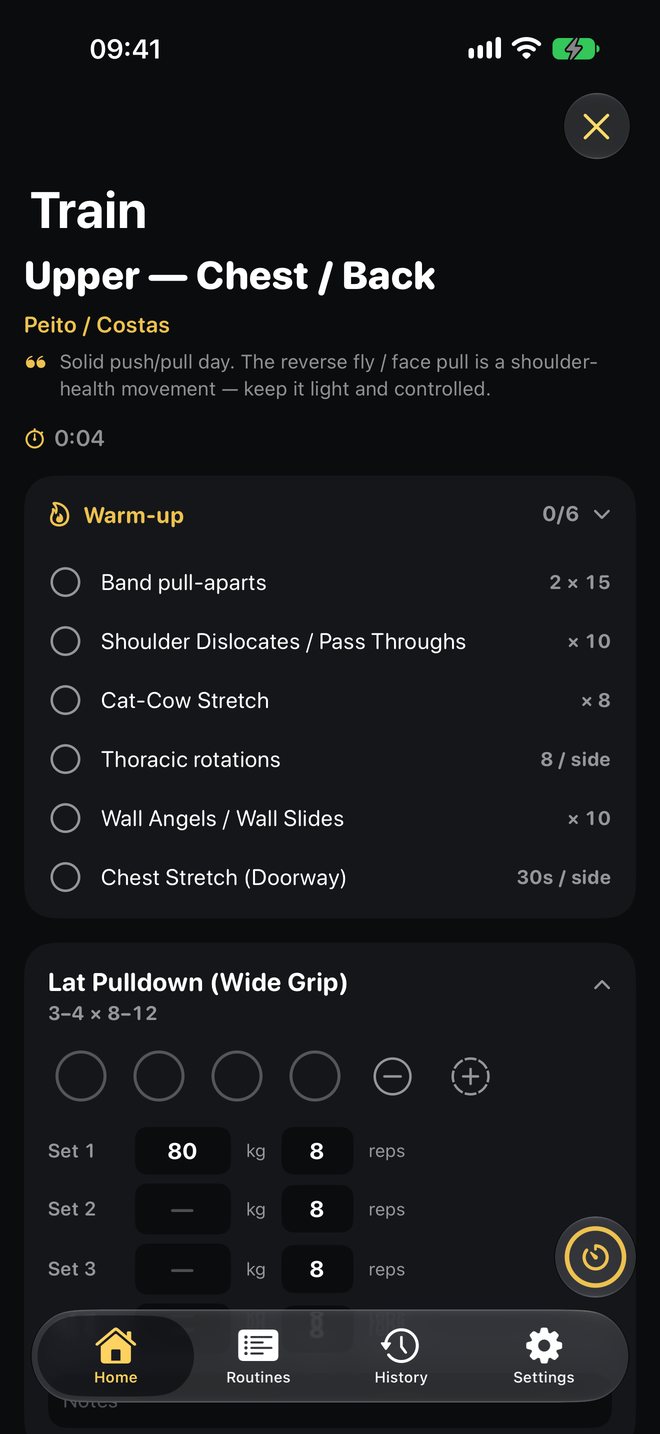
Download the routine file below (push-pull-legs.liftloggr.json). On your iPhone, open it from Safari’s downloads or the Files app, tap Share and choose LiftLoggr. You can also import it in the app: Settings → Data → Import workout templates → Open JSON file.
LiftLoggr shows what’s in the file (the number of routines, exercises and sets) and imports nothing until you tap Import. The six sessions arrive as routines, with sets, rep ranges, target RIR and notes. Importing the same file twice doesn’t create duplicates. Assign weekdays in each routine’s editor if you want the Home screen to follow a fixed week; otherwise it follows the routine order.
What the app does with it:
- Weights. The file carries no weights, so your first session starts with empty weight fields. Enter what you lift. From the next session on, each set is pre-filled from last time, with last time’s weight and reps beside it.
- Progression. When every working set of an exercise reached the top of its range, LiftLoggr pre-fills the next session one step heavier. If you logged RIR 3 or more on every set, it adds two steps. On light dumbbells, where one step is more than 10% of the load, it asks for a few reps above the range first.
- Stalls. Three sessions in a row below the bottom of the range at the same weight trigger a deload suggestion of about 10%.
- Bodyweight pull-ups pre-fill from last time but don’t get an automatic weight step. Add load yourself once all three sets reach 10.
Pre-fills follow the exercise, not the routine. That is why the B days use different lifts: a bench press logged on Push A won’t pre-fill a different press on Push B.
Questions
Is push pull legs good for beginners?
The 3-day version is. Six days a week is a lot of gym time for someone still learning the lifts. Start with three sessions a week, or with the full-body 3-day plan, and move to six days once you recover well and your sessions are consistent.
Should I run PPL 3 or 6 days a week?
Six days if you can recover and want the most volume: every muscle gets trained twice a week. Three days if your schedule is tight: each muscle is trained once a week, so add a set to the first two exercises of each day to keep weekly volume up.
PPL vs upper/lower: which is better?
Neither, when weekly sets are matched. Research finds frequency matters little once volume is equal. Choose by days available: 4 days suits upper/lower, 6 days suits push pull legs, 3 days suits full body or PPL on a two-week rotation.
How long should a PPL session take?
About 55–70 minutes: 15–18 working sets, 2–3 minutes of rest on the big lifts and 60–90 seconds on isolation work, plus 5–10 minutes of warm-up.
Can I use dumbbells only?
Mostly. Swap the barbell bench for a dumbbell bench press, the barbell row for one-arm dumbbell rows and the squat for a goblet squat or Bulgarian split squat. Cable work needs a substitute such as dumbbell flyes and overhead dumbbell extensions.
Sources
- Schoenfeld, Ogborn & Krieger 2016, training frequency and hypertrophy (Sports Med) pubmed.ncbi.nlm.nih.gov
- Schoenfeld, Grgic & Krieger 2019, frequency meta-analysis revisited (J Sports Sci) pubmed.ncbi.nlm.nih.gov
- Schoenfeld, Ogborn & Krieger 2017, weekly sets and muscle growth (J Sports Sci) pubmed.ncbi.nlm.nih.gov
- ACSM 2009 position stand, progression models in resistance training pubmed.ncbi.nlm.nih.gov
- Robinson et al. 2024, proximity to failure, strength and hypertrophy (Sports Med) pubmed.ncbi.nlm.nih.gov
- Schoenfeld et al. 2016, longer rest periods and strength and hypertrophy (J Strength Cond Res) pubmed.ncbi.nlm.nih.gov
- Bell et al. 2023, deloading Delphi consensus (Sports Med Open) pubmed.ncbi.nlm.nih.gov