
Key takeaways
- 013 days a week, Workout A and Workout B alternating, 45–55 minutes each.
- 02Two versions: barbell and machine. Same structure, same rules.
- 03Weeks 1–2: 2 sets, easy. Weeks 3–12: 3 sets, adding reps then weight.
- 04Add 2.5 kg (5 lb) once every set reaches 12 reps (15 on small lifts).
On this page
- Days per week
- 3
- Level
- Beginner
- Length
- 12 weeks
- Equipment
- Barbell version: barbell, rack, bench, lat pulldown, cable row, leg press, leg curl, cable station, dumbbells. Machine version: selectorized machines and cables only.
A .liftloggr.json routine file. Open it on your iPhone and choose LiftLoggr to import every day of the plan.
The schedule
Day 1 Workout A
| Exercise | Sets | Reps | RIR | Notes |
|---|---|---|---|---|
| Barbell Back Squat (High Bar) | 3 | 8-12 | 2 | Weeks 1–2: 2 sets, start with the empty bar |
| Barbell Bench Press | 3 | 8-12 | 2 | Use safety arms or a spotter |
| Lat Pulldown (Wide Grip) | 3 | 8-12 | 2 | |
| Lying Leg Curl | 2 | 10-15 | 2 | |
| Cable Triceps Pushdown (Rope) | 2 | 10-15 | 2 |
Day 2 Workout B
| Exercise | Sets | Reps | RIR | Notes |
|---|---|---|---|---|
| Romanian Deadlift (RDL) | 3 | 8-12 | 2 | Hinge at the hips; bar stays against the legs |
| Barbell Overhead Press (Strict) | 3 | 8-12 | 2 | |
| Seated Cable Row (Close Grip) | 3 | 8-12 | 2 | |
| Leg Press | 2 | 10-15 | 2 | |
| Dumbbell Bicep Curl (Standing) | 2 | 10-15 | 2 |
Progression
Double progression. Each exercise has a rep range, 8–12 for big lifts and 10–15 for small ones. Keep the weight until every working set reaches the top of the range with about 2 reps in reserve, then add one step: 2.5 kg (5 lb) on a barbell, the next pin on a machine stack, the next dumbbell. Reps fall back; climb again. Weeks 1–2 don't progress: they find your starting weights.
Deload
Week 7 is a planned lighter week: 2 sets per exercise, about 10% less weight, 3–4 reps in reserve. If a lift misses the bottom of its range three sessions in a row at the same weight, drop it about 10% and climb back up.
A good gym workout plan for beginners is three full-body sessions a week, alternating two workouts, with 4–5 exercises each and the same lifts getting a little heavier every week or two. This 12-week plan does exactly that, in a barbell version and a machine version.
Weeks 1–2 teach the movements and find your starting weights. Weeks 3–12 add reps, then weight, by one simple rule. Below: both versions, the 12-week phases, a worked log, the effort target, the progression rule and the mistakes that stall most beginners.
The weekly schedule
Two workouts, A and B, on three non-consecutive days. They alternate, so each week starts with the workout you didn’t do first last week.
| Week | Mon | Wed | Fri |
|---|---|---|---|
| 1, 3, 5, 7, 9, 11 | A | B | A |
| 2, 4, 6, 8, 10, 12 | B | A | B |
Over any two weeks, you do each workout three times. Tuesday/Thursday/Saturday works just as well. Never train two days in a row on this plan: every session works the whole body.
Barbell version
This is the version in the routine file. Every exercise is in LiftLoggr’s exercise library under the same name.
Workout A
| Exercise | Sets | Reps | Rest |
|---|---|---|---|
| Barbell back squat | 3 | 8–12 | 2–3 min |
| Barbell bench press | 3 | 8–12 | 2–3 min |
| Lat pulldown (wide grip) | 3 | 8–12 | 2 min |
| Lying leg curl | 2 | 10–15 | 90 s |
| Cable triceps pushdown | 2 | 10–15 | 60–90 s |
Workout B
| Exercise | Sets | Reps | Rest |
|---|---|---|---|
| Romanian deadlift | 3 | 8–12 | 2–3 min |
| Barbell overhead press | 3 | 8–12 | 2–3 min |
| Seated cable row | 3 | 8–12 | 2 min |
| Leg press | 2 | 10–15 | 90 s |
| Dumbbell biceps curl | 2 | 10–15 | 60–90 s |
Machine version
Same structure, same rep ranges, same rules. Machines guide the path of the weight, so there is less to learn and less to fear on day one. Haugen et al.’s 2023 meta-analysis compared free weights and machines directly and found no difference in strength or muscle growth; each mostly made people stronger on the equipment they trained with. Pick the version you’ll show up for.
Workout A (machines)
| Exercise | Sets | Reps | Rest |
|---|---|---|---|
| Leg press | 3 | 10–15 | 2 min |
| Machine chest press | 3 | 8–12 | 2 min |
| Lat pulldown (wide grip) | 3 | 8–12 | 2 min |
| Lying leg curl | 2 | 10–15 | 90 s |
| Cable triceps pushdown (rope) | 2 | 10–15 | 60–90 s |
Workout B (machines)
| Exercise | Sets | Reps | Rest |
|---|---|---|---|
| Back extension (hyperextension) | 3 | 10–15 | 2 min |
| Machine shoulder press | 3 | 8–12 | 2 min |
| Seated machine row | 3 | 8–12 | 2 min |
| Leg extension | 2 | 10–15 | 90 s |
| Machine biceps curl | 2 | 10–15 | 60–90 s |
To run the machine version in LiftLoggr, import the file, open each routine and replace the barbell lifts with the machines from the exercise library. You can also mix: machine chest press with barbell squats is a perfectly good plan.
The 12 weeks
| Weeks | Sets per exercise | Reps in reserve | What you’re doing |
|---|---|---|---|
| 1–2 | 2 | 3–4 | Learn each lift. Find a weight you can lift for the top of the range with 3–4 reps to spare. No progression yet. |
| 3–6 | Full (3, or 2 on small lifts) | 2–3 | Double progression starts. Add a rep where you can; add weight when every set hits the top. |
| 7 | 2 | 3–4 | Lighter week. Same exercises, about 10% less weight. |
| 8–11 | Full | 1–2 | Push closer to the top of each range. Most lifts should be well above week 3. |
| 12 | Full | 1–2 | Finish. Compare your log with week 3 and choose what’s next. |
ACSM recommends 2–3 days a week and loads in the 8–12 repetition-maximum range for novices. Rhea et al.’s 2003 dose-response meta-analysis found untrained lifters made their best strength gains with moderate loads, each muscle trained about 3 days a week and around 4 sets per muscle group. This plan sits close to that: moderate weights, and every major muscle trained 1–3 times a week through a big lift on one day and a related lift on the other.
Effort: what 2 reps in reserve means
Reps in reserve (RIR) is how many more clean reps you could have done when you stopped. RIR 2: you could have done two more, and the last rep was noticeably slower than the first. Zourdos et al. (2016) built a scale on this idea and found lifters could rate it usefully.
Beginners usually underestimate what they have left. In week 1, if you finish a set of 12 and could clearly do 6 more, that is fine: the weight goes up next session. Don’t train to failure in the first 12 weeks; the gains come without it, and technique holds up better. More in RIR vs RPE.
Load and progression
From week 3, one rule for every exercise:
- Do all sets at the same weight.
- Next session, beat at least one set by a rep.
- When every set reaches the top of the range (12, or 15 on small lifts), add one step: 2.5 kg (5 lb) on a barbell, the next pin on a machine, the next dumbbell.
- Reps drop back toward the bottom of the range. Climb again.
A worked example, weeks 3–6
Barbell back squat, Workout A, 3 × 8–12. Workout A falls twice in odd weeks and once in even weeks.
| Week | Day | Weight | Set 1 | Set 2 | Set 3 | Decision |
|---|---|---|---|---|---|---|
| 3 | Mon | 40.0 kg | 12 | 11 | 10 | Stay |
| 3 | Fri | 40.0 kg | 12 | 12 | 12 | Add 2.5 kg |
| 4 | Wed | 42.5 kg | 12 | 11 | 10 | Stay |
| 5 | Mon | 42.5 kg | 12 | 12 | 12 | Add 2.5 kg |
| 5 | Fri | 45.0 kg | 11 | 10 | 10 | Stay |
| 6 | Wed | 45.0 kg | 12 | 12 | 11 | Stay |
Five kilograms in four weeks, on top of the warm-up weight finding of weeks 1–2. Beginners can often move faster than this; let the rule decide. The full method is in double progression.
Warm-ups. Before the first heavy set of the squat, bench, RDL and overhead press, do 2–3 lighter ramp sets: empty bar, then half the working weight, then about three quarters. The warm-up calculator works them out.
Weekly volume per muscle
Direct working sets per week, averaged over two weeks (weeks 3–12, barbell version):
| Muscle | Direct sets / week |
|---|---|
| Quads | 7.5 (squat and leg press) |
| Hamstrings and glutes | 7.5 (RDL and leg curl, plus the squat) |
| Chest | 4.5 (bench) |
| Back | 9 (pulldown and cable row) |
| Shoulders | 4.5 (overhead press, plus the bench) |
| Biceps | 3 (curl, plus both pulls) |
| Triceps | 3 (pushdown, plus both presses) |
That is a deliberately modest dose for the first three months. It is enough to grow, and it leaves room to add sets later. Check it with the weekly volume calculator.
Common mistakes
- Starting too heavy. The first two weeks are for technique. The weight will catch up within a month.
- Changing the program every week. The plan only works if the same exercises get heavier. Same lifts for 12 weeks.
- Skipping legs. Workout A and B both start with legs on purpose.
- Not writing anything down. You can’t beat last week’s reps if you don’t know them. See how to track workouts, or print the workout log template.
- Rushing rest. Two minutes between big sets feels long. It’s what lets you hit the reps.
- Training to failure. Stop with 2 reps in reserve. Sore for four days means you went too hard.
- Adding weight on a bad rep. If the last rep needed a bounce or a twist, it doesn’t count toward the top of the range.
What to run after 12 weeks
| You want | Run next |
|---|---|
| The same, with more volume | Full body 3-day |
| 4 days a week | Upper/lower |
| Strength on the big lifts | 5x5 or GZCLP |
| 6 days a week | Push pull legs |
The split chooser compares all eight programs on this site.
Run it in LiftLoggr
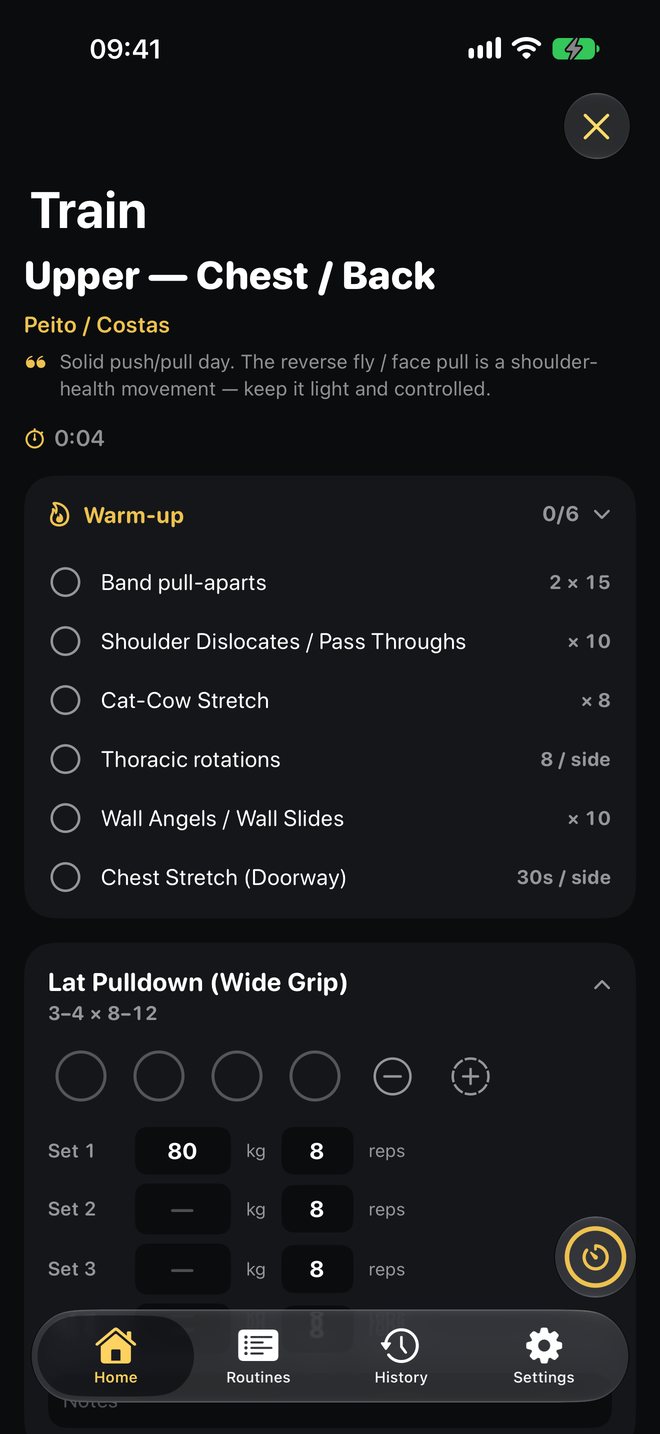
Download the routine file below (beginner-gym-workout-plan.liftloggr.json). On your iPhone, open it from Safari’s downloads or the Files app, tap Share and choose LiftLoggr. Or in the app: Settings → Data → Import workout templates → Open JSON file.
LiftLoggr shows what’s in the file and imports nothing until you tap Import. You get two routines, Workout A and Workout B, with sets, rep ranges, target RIR and notes, using the barbell version. Importing the same file twice doesn’t duplicate them.
- Weeks 1–2: the file sets 3 sets on the big lifts. Do 2, and leave the third empty or remove it in the session.
- First session: weight fields start empty; the file carries no weights. Enter what you lift.
- After that: every set is pre-filled from last time, with last time’s weight and reps beside it.
- Progression: when every working set reached the top of the range, LiftLoggr pre-fills the next session one step heavier, or two steps if you logged RIR 3 or more on every set.
- Stalls: three sessions below the bottom of the range at the same weight bring up a deload suggestion of about 10%.
- Warm-ups: open a routine, pick an exercise and switch on Auto warm-up sets. LiftLoggr then builds the warm-up sets from your first working set.
Questions
Should a beginner use machines or free weights?
Either works. A 2023 meta-analysis found no difference in strength or muscle growth between free-weight and machine training when compared directly; each mostly improves strength on the equipment you train with. Machines are easier to learn; barbells teach skills you'll keep using. Start with the version you'll actually do.
Is this plan good for women?
Yes. The plan, the rep ranges and the progression rule are the same for women and men. Starting weights differ from person to person, not by sex, which is why the plan starts with two easy weeks to find them.
How many days a week should a beginner go to the gym?
Three. ACSM recommends 2–3 days a week for novices, and the CDC's minimum for adults is muscle-strengthening work on at least 2 days a week. Three full-body sessions train every muscle about 1.5 times a week with rest days between.
What weight should I start with?
Light. In weeks 1–2, pick a weight you could lift 3–4 more times at the end of each set. On barbell lifts, that is often the empty 20 kg (45 lb) bar. You'll add weight soon; learning the movement comes first.
What do I do after 12 weeks?
If weights are still climbing, keep going. If you want more training days, move to a 4-day upper/lower split. If you want to focus on strength, a linear-progression program like 5x5 or GZCLP is the next step.
Sources
- ACSM 2009 position stand, progression models in resistance training pubmed.ncbi.nlm.nih.gov
- Rhea et al. 2003, dose response for strength development (Med Sci Sports Exerc) pubmed.ncbi.nlm.nih.gov
- Haugen et al. 2023, free weights vs machines meta-analysis (BMC Sports Sci Med Rehabil) pubmed.ncbi.nlm.nih.gov
- CDC, adult physical activity guidelines overview cdc.gov
- Zourdos et al. 2016, RPE scale based on reps in reserve (J Strength Cond Res) pubmed.ncbi.nlm.nih.gov