
Key takeaways
- 01Heavy compound lifts: 2–3 min, up to 5 min for near-max sets.
- 02Isolation and machine work: 1–2 min.
- 03Resting less than 60 s costs reps; beyond about 90 s, extra rest adds little for muscle growth.
- 04Keep rest consistent per exercise so your log compares like with like.
On this page
Rest 2–3 minutes between sets of heavy compound lifts such as squats, bench presses and rows, and 1–2 minutes between sets of isolation work such as curls and lateral raises. Rest up to 5 minutes before near-maximal sets of 1–5 reps.
The rule behind those numbers: rest long enough that the next set isn’t cut short. Resting too little costs reps; resting longer than you need mostly costs time.
Rest times by exercise and goal
| Exercise | Reps | Rest | Why |
|---|---|---|---|
| Squat, bench, deadlift, overhead press | 1–5 | 3–5 min | Near-maximal; every rep needs full recovery |
| Squat, bench, deadlift, overhead press | 6–10 | 2–3 min | Heavy enough that short rest drops reps |
| Rows, pulldowns, leg press, dumbbell presses | 8–12 | 1.5–2.5 min | Large muscles, moderate loads |
| Curls, raises, extensions, calves | 10–20 | 1–1.5 min | Small muscles recover fast |
| Supersets (A1/A2) | — | 0 between, 1.5–2 min after the pair | The partner exercise is the rest |
| Drop sets | — | 0 between drops, full rest after | One extended set |
| Warm-up sets | 1–10 | 30–60 s, then 1–2 min before work | Practice, not training |
The American College of Sports Medicine’s position stand gives the same shape: 3–5 minutes between heavy strength sets and 1–2 minutes for moderate-load hypertrophy work (ACSM 2009).
What the research says
For strength
A systematic review of 23 studies concluded that strength gains are possible even with short rests under 60 seconds, but that trained lifters need more than 2 minutes to maximise them. Untrained lifters did well with 60–120 seconds (Grgic et al. 2018).
For muscle growth
The old advice was 30–90 seconds “for the pump”. The trials don’t support it.
- In an 8-week study of trained men doing 3 sets of 8–12 reps on 7 exercises, 3-minute rests produced more strength and more thigh muscle than 1-minute rests (Schoenfeld et al. 2016).
- A 2017 systematic review found both short and long rests can build muscle, with a possible advantage for longer rests in trained lifters (Grgic et al. 2017).
- A 2024 Bayesian meta-analysis of 9 studies found a small benefit to resting more than 60 seconds, and no appreciable difference beyond 90 seconds (Singer et al. 2024).
The likely mechanism is plain: short rests cut the reps you can do on later sets, and fewer quality reps mean less stimulus. Once rest is long enough to keep your reps, more rest adds little.
What short rest does to a log
An illustration of the usual pattern, bench press 3 × 8–12 at 80 kg, same lifter on three different days:
| Rest | Set 1 | Set 2 | Set 3 | Total reps |
|---|---|---|---|---|
| 3:00 | 10 | 9 | 9 | 28 |
| 1:30 | 10 | 8 | 7 | 25 |
| 1:00 | 10 | 7 | 5 | 22 |
The first set doesn’t change. The later sets pay. Two things follow:
- Short rest can fake a stall. If you rushed last Thursday, the 7 on set 3 isn’t a sign you’ve stopped progressing. It’s the clock.
- Keep rest the same per exercise. Progress tracking compares set 3 with set 3. That only works if rest before set 3 is similar. Read how to track progressive overload.
What rest costs in session time
Rest is most of a lifting session. A set of 8–12 reps takes about 40 seconds; the rest after it takes two to four times that. Here is the arithmetic for a typical 5-exercise session of 15 working sets, with about 40 seconds per set:
| Rest per set | Rest total | Lifting total | Session (without warm-ups) |
|---|---|---|---|
| 1:00 | 15 min | 10 min | about 25 min |
| 1:30 | 22.5 min | 10 min | about 33 min |
| 2:00 | 30 min | 10 min | about 40 min |
| 3:00 | 45 min | 10 min | about 55 min |
| Mixed: 3:00 on 2 compounds, 1:30 on 3 accessories | 31.5 min | 10 min | about 42 min |
The mixed row is how most good programs run: long rest where it buys reps, short rest where it doesn’t. It costs about 10 minutes more than flat 90-second rests and keeps the big lifts honest.
Rest also changes with the set
- The last set of an exercise needs no timed rest before the next exercise beyond the time it takes to set up, unless the next exercise uses the same muscles.
- After a near-failure set (0–1 reps in reserve), add 30–60 seconds. Effort, not just weight, sets the recovery you need. See RIR vs RPE.
- Lower body costs more than upper body. A set of 8 squats leaves you more out of breath than a set of 8 curls; give legs the long end of the range.
- Hot gym, high altitude, a cut. All add to recovery time. Let the reps decide: if set 2 drops more than 2 reps below set 1, rest longer next time.
Short on time?
Don’t cut rest on the first two lifts. Cut it elsewhere:
- Pair antagonists. Bench with rows, curls with pushdowns. Rest after the pair. See how to log supersets.
- Drop a set from accessories, not rest from compounds. Count what’s left with the weekly volume calculator.
- Use a drop set for the last set of an isolation exercise: two sets of work in one. More in set types.
- Shorten warm-up rests. Light warm-up sets need 30–60 seconds. See warm-up sets.
Mistakes
- Resting by feel on heavy sets. Feeling ready after 90 seconds isn’t the same as being ready. Time it.
- Starting the clock late. Rest starts when the set ends, not after you’ve re-racked, checked your phone and talked.
- Scrolling through the rest. Two minutes becomes five. A timer that buzzes helps.
- Same rest for everything. 3 minutes between lateral raise sets wastes 10 minutes a session.
- Treating short rest as “intensity”. Fatigue isn’t the goal. Reps at a given load are.
How the LiftLoggr rest timer works
LiftLoggr starts the rest timer for you and remembers how long each exercise needs.
- Auto-start. Check a set and the rest starts. Turn it off in the timer sheet with the Auto-start switch.
- Per-exercise memory. Pick 60, 90 or 120 seconds, or adjust in 15-second steps (from 5 seconds up to 60 minutes). The exercise you’re on remembers that length; the next session uses it again. Squats keep 3:00 and curls keep 1:00.
- +30s while running, for the set that needs a bit more.
- Supersets. No rest between A1 and A2. The timer starts after the round is complete.
- Drop sets. No rest before an unchecked drop set; the timer starts after the last drop.
- Off the phone. The countdown shows on the Lock Screen and in the Dynamic Island as a Live Activity, and on the Apple Watch, which taps your wrist when rest ends.
- Sound and voice. A rest-end sound, a notification if you allow rest alerts, and with the voice coach on (English or European Portuguese), a spoken cue with 10 seconds left on rests of 30 seconds or more while the app is open.
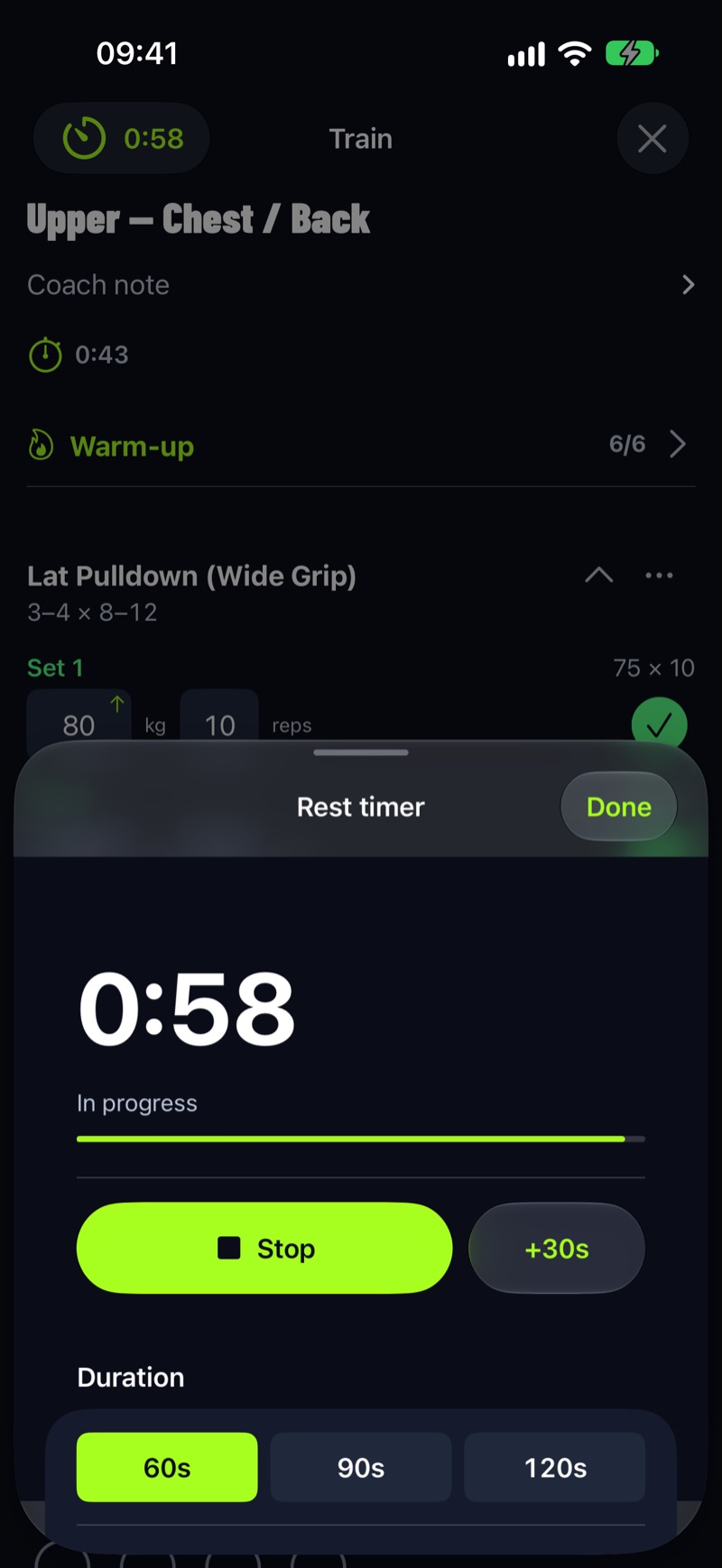
The timer works offline and needs no account. For the full feature, see the rest timer page; for the watch side, Apple Watch weightlifting.
Questions
How long should you rest between sets for hypertrophy?
1.5–3 minutes on compound lifts and 1–2 minutes on isolation work. A 2024 meta-analysis found a small benefit to resting more than 60 seconds and no clear extra benefit beyond about 90 seconds.
How long should you rest between sets for strength?
2–5 minutes on heavy compound lifts. A systematic review concluded trained lifters need more than 2 minutes to maximise strength gains, while untrained lifters do well with 1–2 minutes.
Is 1 minute rest between sets enough?
For isolation exercises and light sets, often yes. For heavy squats, presses and rows it costs reps on the following sets, and in one 8-week study 1-minute rests produced less strength and muscle gain than 3-minute rests.
Is 3 minutes rest too long?
Not for heavy compound sets. It is long for curls and raises, where 60–90 seconds is usually enough. If time is short, keep long rests for the first lifts and shorten them on accessories.
How long should you rest between supersets?
Move straight from the first exercise to the second, then rest 1.5–2 minutes after the pair. Antagonist pairs such as a press with a row recover well this way.
Sources
- ACSM 2009, Progression models in resistance training for healthy adults (position stand) pubmed.ncbi.nlm.nih.gov
- Schoenfeld et al. 2016, Longer interset rest periods enhance muscle strength and hypertrophy (J Strength Cond Res) pubmed.ncbi.nlm.nih.gov
- Grgic et al. 2018, Rest interval duration and muscular strength: systematic review (Sports Med) pubmed.ncbi.nlm.nih.gov
- Grgic et al. 2017, Short vs long inter-set rest and muscle hypertrophy: systematic review (Eur J Sport Sci) pubmed.ncbi.nlm.nih.gov
- Singer et al. 2024, Inter-set rest interval duration and hypertrophy: Bayesian meta-analysis (Front Sports Act Living) pubmed.ncbi.nlm.nih.gov